


Slowscreen SlowScreen
Toggle sidebar

Just launched: free lifetime premium for the first 1,000 members to activate their account.

Start free

Five Little Ducks

Sufficient

Recommended age Unlock

Co-watching from age 5

Stimulating

Exact score locked

Watch on Prime Video Tubi TV
Save
Five Little Ducks

Share

Pass this find on to another parent

Link preview

LooLoo Kids: Five Little Ducks | Sufficient, co-watching from age 5

LooLoo Kids: Five Little Ducks | Sufficient, co-watching from age 5 - Slowscreen

Sufficient · Co-watching from age 5. A sung nursery rhyme follows a family of ducks at a brightly coloured lake. Five ducklings swim off to play one at a time,...

slowscreen.com

https://slowscreen.com/en/series/looloo-kids/s1/e2-five-little-ducks

https://slowscreen.com/en/series/looloo-kids/s1/e2-five-little-ducks

Slowscreen

LooLoo Kids: Five Little Ducks | Sufficient, co-watching from age 5 - Slowscreen

Sufficient · Co-watching from age 5. A sung nursery rhyme follows a family of ducks at a brightly coloured lake. Five ducklings swim off to play one at a time,...

LooLoo Kids: Five Little Ducks | Sufficient, co-watching from age 5

slowscreen.com

LooLoo Kids: Five Little Ducks | Sufficient, co-watching from age 5 - Slowscreen

Sufficient · Co-watching from age 5. A sung nursery rhyme follows a family of ducks at a brightly coloured lake. Five ducklings swim off to play one at a time,...

LooLoo Kids: Five Little Ducks | Sufficient, co-watching from age 5
slowscreen.com

LooLoo Kids: Five Little Ducks | Sufficient, co-watching from age 5 - Slowscreen

slowscreen.com · Posted by you

LooLoo Kids: Five Little Ducks | Sufficient, co-watching from age 5 - Slowscreen

0 Share
LooLoo Kids: Five Little Ducks | Sufficient, co-watching from age 5
To
Subject LooLoo Kids: Five Little Ducks | Sufficient, co-watching from age 5

Sufficient · Co-watching from age 5. A sung nursery rhyme follows a family of ducks at a brightly coloured lake. Five ducklings swim off to play one at a time,...

https://slowscreen.com/en/series/looloo-kids/s1/e2-five-little-ducks

Share on WhatsApp Share on X Share on Facebook Share on Telegram Share on Reddit Share on Email

See the exact scores

The review is yours to read. Create a free account to reveal the exact SlowScreen score and every pillar score.

Create free account
This program is stimulating. It actively demands attention and can feel intense. For the recommended age, this may be on the more intense side. The pacing is fast. Images follow each other quickly, leaving little time to pause and take in what is happening. The sound is intense and continuously present. The visuals are busy, with a lot of movement and frequent changes.
The episode follows one clear thread: five ducklings swim off one by one and the count drops each verse until they all return. Every verse adds only a single small change, the new number, so a young child is never asked to hold too much at once. The beginning, middle and end are easy to recognise, which helps a toddler follow along and guess what comes next. The one soft spot is the logic of why the ducks vanish and reappear, which is never really explained and works more as a counting device than a clear chain of cause and effect.
The mood stays warm and steady the whole way through. Mommy duck calls gently for her ducklings, and the story carries a caring parent-and-child feeling with no shouting, fright or harsh moments. The mild worry of the missing ducks is fully put right when daddy duck calls and all five come swimming back together. The small caveat for this age is that the reassurance only arrives at the very end, so the slight unresolved feeling of each missing duckling lingers across most of the song before it is settled.
The ducks face a clear situation, the little ones wander off, but nobody works through it; daddy duck simply calls and they all reappear at once. There is no visible thinking, trying or step-by-step solving for a child to follow, and the missing ducks return almost as if by magic rather than through any plan. Initiative goes no further than the parents calling out, and the resolution is a single implicit step instead of a worked-out idea. A child watching is given very little to puzzle over or copy in terms of solving a problem.
The words are short, concrete and clearly sung, which fits a two-to-four-year-old well. Simple lines like 'Five little ducks went swimming one day' repeat with just the number changing, giving steady practice with counting down from five. Sentences stay complete, and the language is consistent and easy to understand throughout. The main caveat is that a large share of each verse is the repeated 'quack, quack, quack, quack', which is playful rather than informative, so the genuinely descriptive language is fairly thin.
The world is largely imaginary: glossy ducks with big eyes, whimsical treehouses and brightly coloured pom-pom trees, with ducks that disappear and return on cue. Little of what happens transfers to a child's own day beyond counting and singing along, and the events themselves are not things a toddler can recognise and copy. What does land is the family pattern, a parent fretting over wandering little ones and the relief of having them all back, which echoes a real and familiar relationship. For this age, where a little imagination is fine, the heavy fantasy and thin real-world link keep the practical value low.

More information

This score shows how inclusively the series portrays diverse people, families and cultures. Scale: Limited → Varied → Rich → Inclusive.
Five Little Ducks builds a counting song around one duck family in a pond, with five look-alike yellow ducklings and two white parent ducks. No people appear, so there is no human variation in background, age or body, and the only household shown is a conventional two-parent one. The story also leans on a familiar split: the mother duck calls and worries throughout without success, while the father's single call at the end brings every duckling home. Both who is shown and how they behave stay within a narrow, traditional pattern.
This score shows whether the series stays close to everyday reality or leans into fantasy. Scale: Fantasy → Mixed reality → Realistic.
This counting song plays out entirely at a familiar pond, where a duck family swims, quacks and reunites. There is no villain and no real magic, just the gentle drama of little ducks wandering off over the hills and coming back when called. The mix of a recognizable outdoor world with the light play of counting suits a young child well. It stays close to what a toddler could see on a real walk to the water.
This score shows how enjoyable the series is for parents watching along. Scale: Tedious → Tolerable → Pleasant → Enjoyable.
This is a single nursery rhyme built for toddlers, and there is little here for the adult sitting alongside. The humour and references that would hold a grown-up are absent, and the story is one verse repeated with the count winding down before the ducklings return. The production is clean and the soft melody keeps it from grating, though the looping tune and constant quacking do wear over time. Pleasant enough as background, but not something a parent will lean into.

Themes

Counting

Central

Each verse counts the ducks down from five to four to three and so on until none, then back to all five.

Animals

Central

The entire video features a family of ducks swimming on a lake.

Music

Central

The video is a sung nursery rhyme with continuous melody from start to finish.

Caregiving

Incidental

The parent ducks repeatedly call out to gather their wandering little ones.

Attention hooks

A 'Next song' button with a thumbnail invites the viewer to continue straight to another video.

Separation

The ducklings repeatedly swim away and fail to return as the parent calls, a gentle recurring loss until the final verse.

Stereotypes

Traditional gender roles

Mommy duck calls every verse yet the ducks keep disappearing, and only when daddy duck calls in the last verse do all five return.

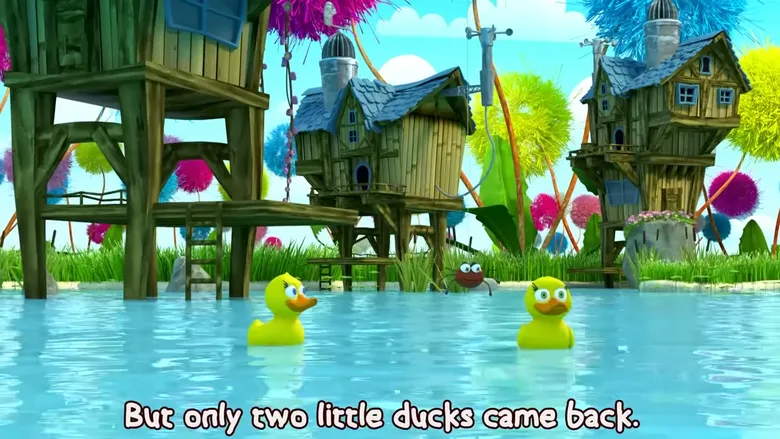
A sung nursery rhyme follows a family of ducks at a brightly coloured lake. Five ducklings swim off to play one at a time, and each verse counts down as fewer return when mommy duck calls. When daddy duck calls in the final verse, all five ducklings come swimming back together. The video then closes on a card with buttons to subscribe, open a playlist, and go to the next song.

Videos

a selection of popular and recent videos

LooLoo Kids

LooLoo Kids

Wheels On The Bus - Learn Colors

Overstimulating
recommended age Unlock co-watching from 5
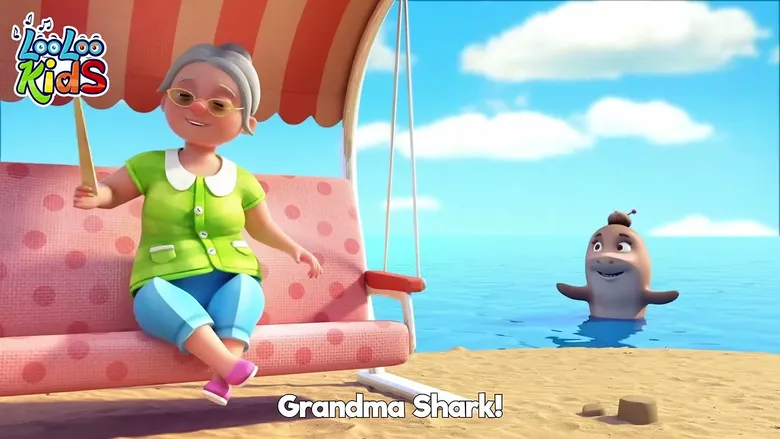
A 3D-animated baby called Johny appears throughout, alternating between scenes filled with bright coloured balls and several versions of the Johny Johny Yes Papa rhyme. In that rhyme a father asks Johny whether he has been eating sugar, Johny denies it, then opens his mouth and both laugh. Two renditions of Wheels on the Bus show colourful buses and a singing family, and colour names like red, orange, green and blue are announced between songs. The compilation closes on the Johny Johny rhyme and laughter.

LooLoo Kids

LooLoo Kids

Learn Colors with Colorful Balloons and Superheroes

Overstimulating
recommended age Unlock co-watching from 5
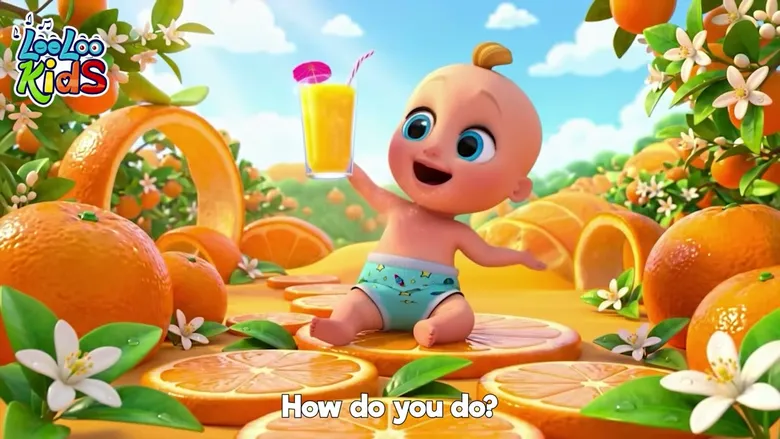
Baby Shark and the shark family are lifted into the air one by one, and a different colored superhero flies in to rescue each of them, from baby to grandpa. A short middle section names balloon colors such as green, yellow and blue, and a Johny Johny Yes Papa verse shows a baby caught sneaking sugar. The action plays out on a sunny beach and ocean and then in a child's room. It closes on shared laughter and the LooLoo Kids logo.

LooLoo Kids

LooLoo Kids

Finger Family with Fruits + Johny Johny Yes Papa

Overstimulating
recommended age Unlock co-watching from 5
This is a nursery rhyme medley that joins the Finger Family song, a colour-naming segment and Johny Johny Yes Papa. A baby called Johny, a grandfather figure named Papa and the finger-family members sing and move through bright kitchen and stylised fruit-garden settings while apples, bananas, grapes and other fruits illustrate each colour. Papa gently asks Johny whether he has been eating sugar, Johny denies it, and the moment dissolves into laughter. It closes with the channel's group of children gathered around a branding card.

LooLoo Kids

LooLoo Kids

Wheels On The Bus

Stimulating
recommended age Unlock co-watching from 5
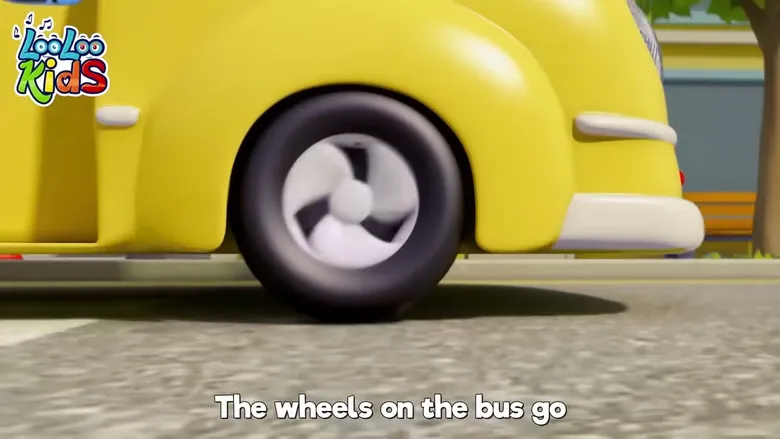
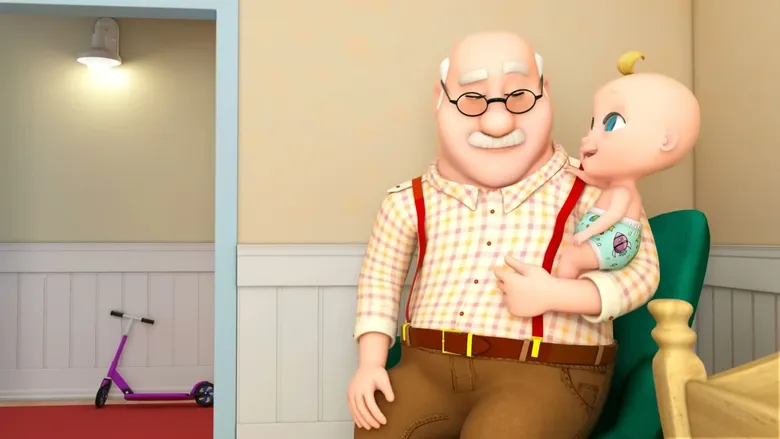
This video strings together two nursery rhymes. In 'Johny Johny Yes Papa', a small child at home is asked by his father whether he has been eating sugar and telling lies, denies it, then opens his mouth and everyone laughs. In 'The Wheels on the Bus', a yellow bus travels through town while the song names its wheels, wipers, horn and doors and the passengers. It closes with the mommy and daddy on the bus saying 'I love you' and 'I love you too'.

LooLoo Kids

LooLoo Kids

Five Little Ducks

Stimulating
recommended age Unlock co-watching from 5
A sung nursery rhyme follows a family of ducks at a brightly coloured lake. Five ducklings swim off to play one at a time, and each verse counts down as fewer return when mommy duck calls. When daddy duck calls in the final verse, all five ducklings come swimming back together. The video then closes on a card with buttons to subscribe, open a playlist, and go to the next song.

LooLoo Kids

LooLoo Kids

Johny Johny Yes Papa

Overstimulating
recommended age Unlock co-watching from 5
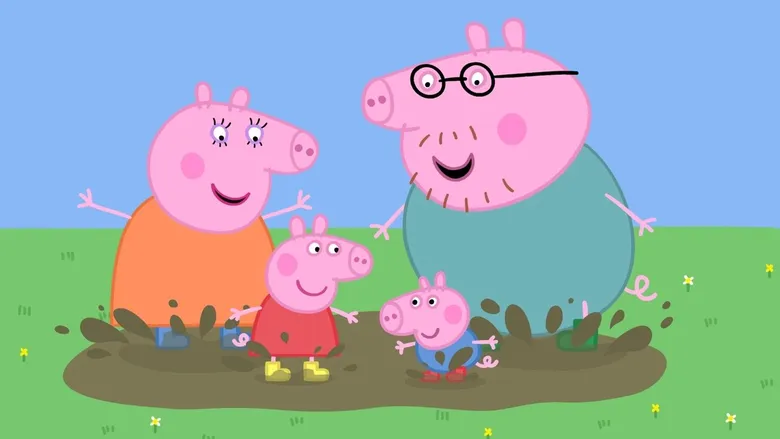
A young animated baby named Johny sneaks sugar from a jar in a home kitchen. His papa, an older man with glasses and suspenders, comes in and asks whether he has been eating sugar and telling lies, and Johny answers 'No, papa' each time. Papa then asks him to open his mouth and the truth comes out, ending in laughter. The single verse and melody repeat twice before a closing screen with subscribe and next-song buttons.

Explore more

From this series LooLoo Kids
By age 3 years

Just launched: free lifetime premium for the first 1,000 members to activate their account.

Create your account

Search by title, show, tag, or topic

We use functional cookies and Google Analytics to improve our site. Learn more