

Slowscreen SlowScreen
Toggle sidebar

Just launched: free lifetime premium for the first 1,000 members to activate their account.

Start free

Pinga in a Box

Sufficient

Recommended age Unlock

Co-watching from age 2

Balanced

Exact score locked

Watch on Prime Video
Save
Pinga in a Box

Share

Pass this find on to another parent

Link preview

Pingu: Pinga in a Box | Sufficient, co-watching from age 2

Pingu: Pinga in a Box | Sufficient, co-watching from age 2 - Slowscreen

Sufficient · Co-watching from age 2. Pingu and his baby sister Pinga turn an empty cardboard box into a hiding place and toy inside their igloo home, popping ou...

slowscreen.com

https://slowscreen.com/en/series/pingu/s6/e7-pinga-in-a-box

https://slowscreen.com/en/series/pingu/s6/e7-pinga-in-a-box

Slowscreen

Pingu: Pinga in a Box | Sufficient, co-watching from age 2 - Slowscreen

Sufficient · Co-watching from age 2. Pingu and his baby sister Pinga turn an empty cardboard box into a hiding place and toy inside their igloo home, popping ou...

Pingu: Pinga in a Box | Sufficient, co-watching from age 2

slowscreen.com

Pingu: Pinga in a Box | Sufficient, co-watching from age 2 - Slowscreen

Sufficient · Co-watching from age 2. Pingu and his baby sister Pinga turn an empty cardboard box into a hiding place and toy inside their igloo home, popping ou...

Pingu: Pinga in a Box | Sufficient, co-watching from age 2
slowscreen.com

Pingu: Pinga in a Box | Sufficient, co-watching from age 2 - Slowscreen

slowscreen.com · Posted by you

Pingu: Pinga in a Box | Sufficient, co-watching from age 2 - Slowscreen

0 Share
Pingu: Pinga in a Box | Sufficient, co-watching from age 2
To
Subject Pingu: Pinga in a Box | Sufficient, co-watching from age 2

Sufficient · Co-watching from age 2. Pingu and his baby sister Pinga turn an empty cardboard box into a hiding place and toy inside their igloo home, popping ou...

https://slowscreen.com/en/series/pingu/s6/e7-pinga-in-a-box

Share on WhatsApp Share on X Share on Facebook Share on Telegram Share on Reddit Share on Email

See the exact scores

The review is yours to read. Create a free account to reveal the exact SlowScreen score and every pillar score.

Create free account
This program is well-balanced. It remains mostly easy to follow and process. It is a good fit for the recommended age. The pacing is fast. Images follow each other quickly, leaving little time to pause and take in what is happening. The sound is clearly present and regularly draws attention. The visuals are calm and well-organized.
The episode follows Pingu and his little sister as a simple cardboard box becomes the focus of play, then shifts to a delivery theme with boxes being carted around the village. The through-line holds together, though the move from home play to the parcel scenes reads as two loosely joined halves rather than one tightly built arc. Each event brings little new information at a time, so a young child can follow what is happening, and physical actions lead to clear, predictable results, like a hidden character being discovered when the box is opened. The clarity is solid, with the join between the two settings as the main soft spot.
Interactions between Pingu, Pinga and their parents are warm and playful, and moments of mild mischief or surprise settle back into calm soon after they arise. The tone stays affectionate, with the family attuned to one another, though the humour leans on physical gags and the odd teasing beat that a sensitive child might read as a small jolt. Emotional shifts arrive gently rather than in sharp swings, and reassurance follows the little bumps. Overall the emotional footing is steady with a few lively edges.
Pingu drives his own play, choosing to climb into the box, hide, and later help move parcels, so initiative clearly comes from the character rather than being forced on him. The trying-and-seeing is visible in short bursts, hiding then being found, pushing a box and watching it tip, which suits what a three-year-old can follow. The solutions tend to be simple and playful rather than worked through in several deliberate steps, so the thinking on show stays light. There is enough self-started doing here to model curiosity, with limited depth to the problem-solving itself.
There is no real spoken language to learn from here; the characters communicate only in grunts, honks and expressive noises rather than words or sentences. Meaning comes through tone, gesture and facial expression, which carries the emotion clearly but offers a child nothing to imitate verbally and no vocabulary or sentence structure to absorb. The sounds are consistent with what is happening on screen, so intent is readable, yet almost nothing functions as information or instruction. For language building specifically, this episode gives very little to hold onto.
Much of what happens maps straight onto a young child's own world: playing inside a cardboard box, family life in the home, and loading and delivering parcels around the neighbourhood. Box play in particular is easy to copy at home with everyday objects, and the family and community moments reflect social patterns a child recognises. The penguins live human-style lives, so the frame is imaginative rather than strictly real, but the activities themselves stay grounded and purposeful. It connects well to offline life, with the animal-family conceit the main step away from the everyday.

More information

This score shows how inclusively the series portrays diverse people, families and cultures. Scale: Limited → Varied → Rich → Inclusive.
The whole cast is penguins living in a snowy village of iglos, centered on one family with a mother, father, older brother and baby sister. Because everyone shares the same look and one household sits at the heart of the story, the world offers little variation in how people live or who they are. Pingu drives most of the action while his younger sister Pinga follows along and the mother appears in caregiving moments, a fairly traditional pattern. A delivery worker moving parcels between homes adds a small glimpse of a wider community and different daily work.
This score shows whether the series stays close to everyday reality or leans into fantasy. Scale: Fantasy → Mixed reality → Realistic.
This episode plays out in a penguin family's igloo home, with everyday situations any small child recognizes: playing with a box, family members reacting to a power cut, and gentle sibling moments between Pingu and Pinga. The penguins talk in their own babble and walk on two feet, but everything they do maps onto ordinary home life, so the imagination stays light and grounded. No villain appears, and the small bumps come from situations rather than any bad character. The mix of a familiar domestic world with just a touch of make-believe sits comfortably for a three-year-old.
This score shows how enjoyable the series is for parents watching along. Scale: Tedious → Tolerable → Pleasant → Enjoyable.
As a grown-up in the room, this one is easy company. The stop-motion craft is genuinely lovely, the wordless honk-and-squawk language carries clear physical comedy, and the little arc, Pinga hiding in a cardboard box that Pingu then hauls off on a snowy delivery run, holds together well enough to follow. There is not much aimed squarely at adults, so you are watching for the charm rather than hidden jokes, but nothing here will grate on your ears or eyes.

Themes

Play

Central

Pingu and Pinga spend the opening minutes climbing into and hiding inside a cardboard box at home.

Pretend play

Central
The empty box becomes a hiding spot and a toy as the siblings invent games around it.

Mischief

Incidental

Pingu hides under the table and pops out of the box to surprise others.

Mild violence

Pingu tips over, tumbles with the box and takes playful pratfalls accompanied by honking sound effects.

Pingu and his baby sister Pinga turn an empty cardboard box into a hiding place and toy inside their igloo home, popping out to surprise each other. The story then moves outdoors to the snowy village, where Pingu loads parcels onto a sled and helps deliver boxes between the igloos. The family and neighbours appear throughout, and the whole episode is told through claymation with no spoken words. It ends with Pingu back among the boxes after the deliveries are done.

Season 6

11 episodes

Pingu
S06 E01

Pingu

Pingu's Sledge Academy

Balanced
recommended age Unlock co-watching from 2
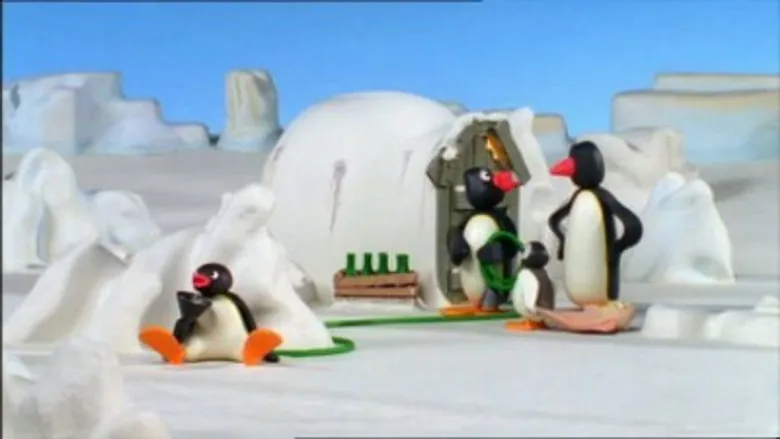
Pingu joins a sledge academy in his snowy village, where an instructor penguin teaches a class of young penguins to ride and steer sledges. Between blackboard lessons, market visits and a balloon party, Pingu practises the runs and takes a few tumbles on the ice. The penguins communicate in expressive sounds rather than words. The episode ends after the practice runs as the village settles into evening.

Pingu
S06 E02

Pingu

Pingu and the Hose

Balanced
recommended age Unlock co-watching from 2
In this Pingu episode, Pingu finds a green hose at his father's workshop and takes it outside to play in the snow. He drags, swings and sprays the hose around snowmen and igloos, crossing paths with other penguins and a seal. His game causes some mild disruption before the episode settles. The story is told through stop-motion animation and non-verbal penguin sounds rather than dialogue.

Pingu
S06 E03

Pingu

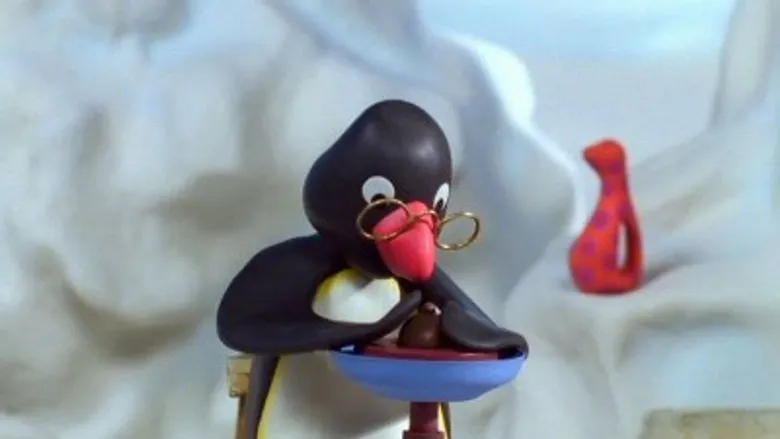
Pottery Pingu

Balanced
recommended age Unlock co-watching from 2
Pingu spends the episode making pottery with his family in their snowy igloo village. Working at a small table, the penguins shape lumps of clay into vases and pots, with Pingu experimenting, clowning around and occasionally getting frustrated with the clay. His baby sister Pinga plays with blocks nearby while the parents work alongside. The episode closes with the family and their finished pottery lined up on the table.

Pingu
S06 E04

Pingu

Pingu and the Litter

Balanced
recommended age Unlock co-watching from 2
Pingu visits a busy penguin market and buys a treat wrapped in shiny red foil. After eating it he drops the wrappers, which blow across the ice and cover doorways, the water hole, and the neighbours' homes. The scattered litter grows into a problem the penguins gather to notice and clear away. The episode closes back near the market once the mess is dealt with.

Pingu
S06 E05

Pingu

Mother's New Hat

Balanced
recommended age Unlock co-watching from 2
Pingu and his family visit a busy outdoor market in their snowy village to look at hats. The mother tries on several before settling on a new one, while Pingu and his little sister play with hats of their own. Back at the igloo, the family gathers at home and the mother shows off her choice. The episode closes with the penguins together indoors.

Pingu
S06 E06

Pingu

Poor Pinga

Balanced
recommended age Unlock co-watching from 2
In this Pingu episode, Pinga, Pingu's little sister, wakes up sick and covered in spots inside the family's igloo home. Pingu dresses up as a nurse and, together with the parents, uses a first-aid kit, a thermometer and plenty of comfort to look after her. The action moves between the bedroom, bathroom and kitchen as the family fusses over the unwell child. By the end Pinga is settled and cared for in bed.

Pingu
S06 E07

Pingu

Pinga in a Box

Balanced
recommended age Unlock co-watching from 2
Pingu and his baby sister Pinga turn an empty cardboard box into a hiding place and toy inside their igloo home, popping out to surprise each other. The story then moves outdoors to the snowy village, where Pingu loads parcels onto a sled and helps deliver boxes between the igloos. The family and neighbours appear throughout, and the whole episode is told through claymation with no spoken words. It ends with Pingu back among the boxes after the deliveries are done.

Pingu
S06 E08

Pingu

Pingu and the Present

Balanced
recommended age Unlock co-watching from 2
Pingu is a young penguin who plays with wooden blocks at home with his mother and baby sister Pinga. A card showing a wrapped present arrives, and Pingu heads out across the snowy landscape to meet friends. Everyone gathers for a birthday party with a candlelit cake, balloons and party hats. The episode ends with the penguins celebrating together at the party table.

Pingu
S06 E10

Pingu

Pingu and the Paper Mache

Balanced
recommended age Unlock co-watching from 2
Pingu and his classmates gather at their outdoor snow-school for a paper mache craft. Working from newspaper strips and paste at their desks, the penguins build lumpy shapes that quickly turn into a sticky, comic mess. Pingu smears paste on himself, tangles with classmates and tumbles through the chaos. The episode closes back with the class after the play winds down.

Pingu
S06 E11

Pingu

Sore Tummy Pingu

Balanced
recommended age Unlock co-watching from 2
Pingu eats a whole box of food at the family meal and soon develops a sore tummy. His family takes him to the igloo hospital, where a doctor examines him and shows a drawing of his overstuffed stomach. Pingu is put to bed to recover, cared for by the staff and his family. The episode is told without real words, using the series' expressive penguin sounds throughout.

Pingu
S06 E12

Pingu

Pingu Gets Carried Away

Balanced
recommended age Unlock co-watching from 2
Pingu, a young penguin, sets off with a rolled striped mat on his motorized sled and works his way through a snowy open-air market full of hat and kitchenware stalls. Along the way he meets a smaller penguin and an adult in a pink apron, and his excitement gets the better of him as he zooms off and gets carried away. His ride takes him well beyond the stalls into an open, sunset-lit landscape. The episode closes with Pingu waving cheerfully after his outing.

Explore more

From this series Pingu
By age 3 years
By platform Prime Video

Just launched: free lifetime premium for the first 1,000 members to activate their account.

Create your account

Search by title, show, tag, or topic

We use functional cookies and Google Analytics to improve our site. Learn more