



Slowscreen SlowScreen
Toggle sidebar

Just launched: free lifetime premium for the first 1,000 members to activate their account.

Start free

Muffy Misses Out

Good

Recommended age Unlock

Co-watching from age 3

Balanced

Exact score locked

Watch on Prime Video BBC PBS Kids
Save
Muffy Misses Out

Share

Pass this find on to another parent

Link preview

Arthur: Muffy Misses Out | Good, co-watching from age 3

Arthur: Muffy Misses Out | Good, co-watching from age 3 - Slowscreen

Good · Co-watching from age 3. Muffy, a confident organizer at Lakewood Elementary, is thrilled to visit Italy with her father but worries about leaving her fri...

slowscreen.com

https://slowscreen.com/en/series/arthur/s21/e6-muffy-misses-out

https://slowscreen.com/en/series/arthur/s21/e6-muffy-misses-out

Slowscreen

Arthur: Muffy Misses Out | Good, co-watching from age 3 - Slowscreen

Good · Co-watching from age 3. Muffy, a confident organizer at Lakewood Elementary, is thrilled to visit Italy with her father but worries about leaving her fri...

Arthur: Muffy Misses Out | Good, co-watching from age 3

slowscreen.com

Arthur: Muffy Misses Out | Good, co-watching from age 3 - Slowscreen

Good · Co-watching from age 3. Muffy, a confident organizer at Lakewood Elementary, is thrilled to visit Italy with her father but worries about leaving her fri...

Arthur: Muffy Misses Out | Good, co-watching from age 3
slowscreen.com

Arthur: Muffy Misses Out | Good, co-watching from age 3 - Slowscreen

slowscreen.com · Posted by you

Arthur: Muffy Misses Out | Good, co-watching from age 3 - Slowscreen

0 Share
Arthur: Muffy Misses Out | Good, co-watching from age 3
To
Subject Arthur: Muffy Misses Out | Good, co-watching from age 3

Good · Co-watching from age 3. Muffy, a confident organizer at Lakewood Elementary, is thrilled to visit Italy with her father but worries about leaving her fri...

https://slowscreen.com/en/series/arthur/s21/e6-muffy-misses-out

Share on WhatsApp Share on X Share on Facebook Share on Telegram Share on Reddit Share on Email

See the exact scores

The review is yours to read. Create a free account to reveal the exact SlowScreen score and every pillar score.

Create free account
This program is well-balanced. It remains mostly easy to follow and process. It is a good fit for the recommended age. The pacing is fast. Images follow each other quickly, leaving little time to pause and take in what is happening. The sound is soft and supportive. The visuals are calm and well-organized.
The story follows one clear line: Muffy fears her friends no longer need her after they run the bake sale without her. Events build logically from her father announcing the Italy trip, through the sale that thrives on new ideas, to her realizing she was missed, with a small Francine and Catherine thread that ties back in. Cause and effect are easy to follow, for example Francine's 'play hard to get' advice failing because she actually talked things out instead. The committee planning scene packs many ideas close together, which is the one place a five-year-old may need a hand keeping up.
Feelings run through the episode: Muffy cries, declares the sale 'a disaster,' dramatically says goodbye to everyone, and two friends squabble over the curtain with jabs like 'you pie-faced possum.' These moments stay mild and are usually settled soon after, as when the friends come to her room and remind her she was missed. The tone is mostly supportive, though Muffy's self-focus and the teasing during the argument soften that warmth. Children see big emotions named and then resolved rather than left hanging.
Characters take real initiative: the friends organize and run the sale, swap cannoli for New Orleans beignets when the original recipe proves too hard, and decide on their own to draw Muffy back in. The thinking is partly visible, such as Francine working out why her advice backfired. The main resolution leans on the friends staging a small crisis to make Muffy feel needed rather than Muffy reasoning her own way out, so the problem-solving is meaningful but not deeply stepped. The link between actions and outcomes stays clear throughout.
Speech is clear, consistent, and purposeful, with characters explaining their plans and feelings in full sentences. The episode reaches for rich words and ideas, introducing 'regional cuisine,' the Renaissance, 'cabinet of curiosities,' and later 'segregation' and 'activist' through context. That range is a strength, with the small caveat that several terms sit above what a five-year-old will grasp without an adult nearby. Most lines inform or describe rather than just exclaim.
Almost everything maps onto real life: planning and running a bake sale, baking, decorating, raising money for the school, and navigating a friendship where you feel left out. These are all things a child can recognize and try offline, and the social dynamics of contributing to a group and feeling valued are very true to life. The closing segment has real children explain who John Lewis was and what the civil rights marches achieved, adding genuine real-world learning. The animal characters are the only step away from realism, and everything around them stays grounded.

More information

This score shows how inclusively the series portrays diverse people, families and cultures. Scale: Limited → Varied → Rich → Inclusive.
This Arthur episode draws on a wide cast and treats cultural background as a natural part of the story, most clearly when Ladonna shares New Orleans beignets, Mardi Gras masks and Dixieland jazz that win over the whole school. A closing live-action segment has real children of different ethnicities explain civil rights leader John Lewis, segregation and the fight for equal rights. The bake sale work is shared across baking, decorating, music and organizing, with both boys and girls taking initiative and no single type carrying every task. The varied origins of the animated cast stay implied through the animal characters rather than shown directly, but the explicit cultural and historical content gives a broad, inclusive picture.
This score shows whether the series stays close to everyday reality or leans into fantasy. Scale: Fantasy → Mixed reality → Realistic.
This episode stays close to everyday life. Muffy plans a school bake sale, travels to Italy with her father, and learns that her friends still value her even after they change the plans she made. There is no villain; the tension grows from her own bruised pride and resolves through honest conversation. The only imaginative touch is the cast of talking animals, a convention that holds steady from start to finish.
This score shows how enjoyable the series is for parents watching along. Scale: Tedious → Tolerable → Pleasant → Enjoyable.
This episode gives the adult in the room plenty to enjoy, from Muffy's theatrical self-pity to Buster's deadpan asides about stale pastry. The story carries a genuine arc as Muffy discovers her friends used her ideas even while changing her plans, so there is something to follow beyond a simple routine. Calm voices and warm colours keep it easy on adult ears, with only Muffy's extended sulking as a mild irritant. The animation and sound are consistent and intentional, including a straightforward closing segment about John Lewis.

Themes

Friendship

Central

The episode centers on Muffy fearing her friends no longer need her after the bake sale

Feeling unnoticed

Central

Muffy declares 'no one needs me' before her friends show that her contributions mattered

Light flashes

Contains rapid flashing that may affect photosensitive viewers.

Flashing lights

A travel montage shows rapid bright camera flashes as Muffy is photographed boarding and arriving

Violence reference

A child explains that John Lewis was beaten by police and arrested during the Selma march

Mild conflict

Ladonna and Binky argue loudly over the curtain with jabs like 'you pie-faced possum'

Stereotypes

Wealth caricature

Muffy excitedly lists 'The opera! The fashion! The pasta!' and packs three suitcases and a ball gown for one week
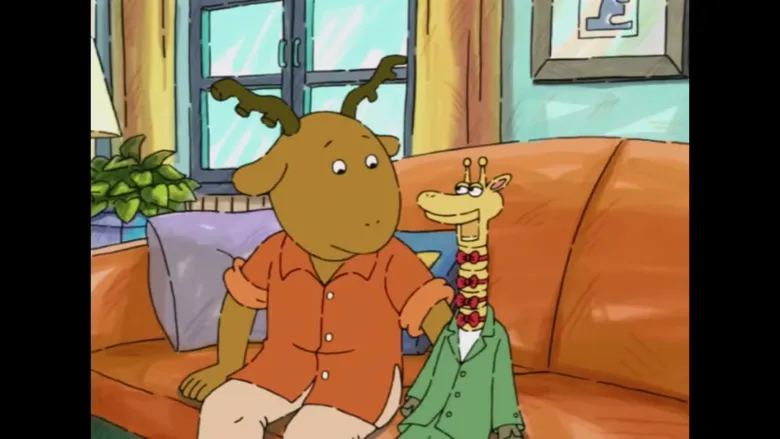
Muffy, a confident organizer at Lakewood Elementary, is thrilled to visit Italy with her father but worries about leaving her friends to run the school bake sale. While she is away, the friends swap her Italian theme for New Orleans beignets and jazz, and the sale is a hit, which leaves Muffy feeling unneeded. When her friends realize how much her ideas and presence meant, they bring her back to help settle a disagreement over decorating the stage curtain. A short closing segment has real children explain who civil rights leader John Lewis was.

Arthur
S13 E03

Arthur

Silent Treatment

Balanced
recommended age Unlock co-watching from 3

George, a quiet moose in the town of Elwood City, becomes convinced his friends never notice him, so he decides to stop talking until someone does. A dream in which his dummy Wally shows a world where George never existed helps him realise he does matter. His friends, who had been secretly planning a surprise party, reveal that he won the woodworking contest, and the group ends up playing hide-n-seek together. Real children then share their own funny misunderstandings.

Arthur
S15 E02

Arthur

I Wanna Hold Your Hand

Balanced
recommended age Unlock co-watching from 3
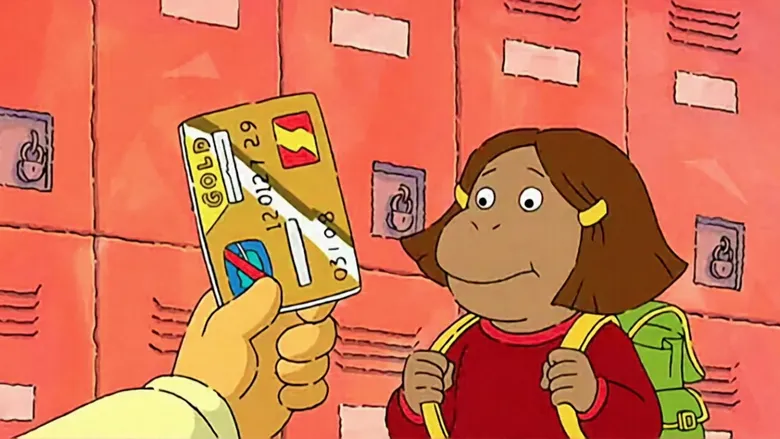
Binky, a member of the Tough Customers, is mortified when his classmate George spots him holding his mom's hand at the mall. Afraid of being called a baby, he tries to keep it secret by silencing and bribing George, while Molly and Rattles dig for clues. After a clarinet recital, Binky decides he loves his mom and will hold her hand no matter what, and his friends shrug it off as nothing unusual. He happily chooses a family dinner over a night out with his friends.

Arthur
S15 E06

Arthur

Cents-Less

Balanced
recommended age Unlock co-watching from 3
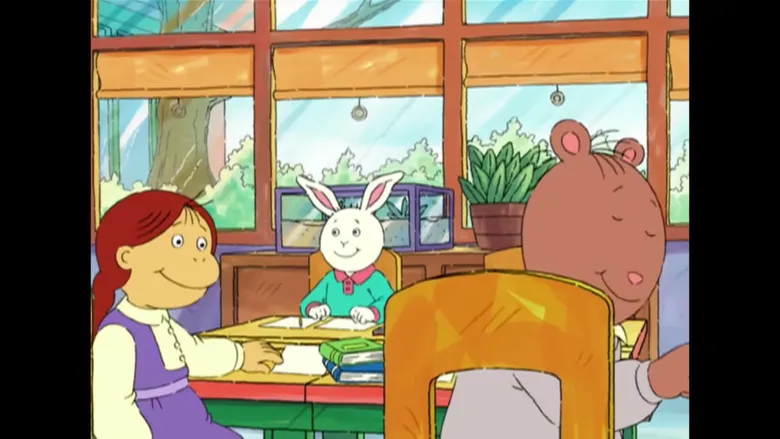
Mr. Ratburn challenges his class to spend no money for a whole weekend and report back on Monday. Muffy, who is used to buying whatever she wants, works through a chain of trades to get a sought-after wrestler figure and finally learns to barter by organising Brain's baseball card collection. Along the way Buster trades jokes for food, Mr. Ratburn revives his old puppets to earn meals, and Francine resists spending a birthday gift. The class returns to school having found they are valuable even without money, and several decide to start saving.

Arthur
S15 E15

Arthur

Through the Looking Glasses

Balanced
recommended age Unlock co-watching from 3

Arthur wakes up unable to find his glasses and has to get a new pair from an eccentric optician. When friends and neighbors start praising his new look, the attention goes to his head and he begins handing out unwanted advice, which pushes his best friend Buster away. After both boys' glasses break, Arthur promises not to let a pair of glasses change who he is, and Buster helps him find his way home. The episode closes with the show's creator demonstrating how to draw the dog Pal.

Arthur
S21 E06

Arthur

Muffy Misses Out

Balanced
recommended age Unlock co-watching from 3

Muffy, a confident organizer at Lakewood Elementary, is thrilled to visit Italy with her father but worries about leaving her friends to run the school bake sale. While she is away, the friends swap her Italian theme for New Orleans beignets and jazz, and the sale is a hit, which leaves Muffy feeling unneeded. When her friends realize how much her ideas and presence meant, they bring her back to help settle a disagreement over decorating the stage curtain. A short closing segment has real children explain who civil rights leader John Lewis was.

Explore more

From this series Arthur
By age 5 years
By platform PBS Kids

Just launched: free lifetime premium for the first 1,000 members to activate their account.

Create your account

Search by title, show, tag, or topic

We use functional cookies and Google Analytics to improve our site. Learn more