


























This program is stimulating. It actively demands attention and can feel intense. For the recommended age, this may be on the more intense side.
The pacing is fast. Images follow each other quickly, leaving little time to pause and take in what is happening.
The sound is soft and supportive.
The visuals are calm and well-organized.
One clear goal drives the whole episode: get Pete's birthday present delivered before Amrita leaves for the moon. The Helpsters break that goal into four numbered jobs and work through them in order, checking each off aloud ('Check! One job done, three more to go'), so the structure is easy to follow from start to finish. Cause and effect stays visible throughout, they need Pete's address before they can plan a route, and they read a real map to find the red house near the park. The small caveat is that a few scenes pack in several new ideas at once, but the constant recap keeps a preschooler oriented.
The tone is warm and steady, with characters who support each other and celebrate small wins together. Emotions stay gentle: the biggest tension is Scatter's eagerness to peek inside the present, and that is met kindly each time ('you can't open a present that doesn't belong to you'), then happily resolved when Pete opens it himself. There is no meanness, no mocking, and no scary turn, so any little worry is quickly reassured. The one soft spot is Scatter's repeated pestering, though it is consistently redirected rather than rewarded.
This episode stands out for showing a full thinking process out loud. Faced with an unfamiliar task, the Helpsters make a plan, generate their own ideas ('who's got an idea?'), and work through real sub-problems: they figure out how to discover where Pete lives by asking people, and when Heart spins in circles they realise they must say which way to turn. Attempts, evaluation and adjustment are all visible, and each solution is built from several concrete steps rather than a quick fix. The problem itself is handed to them by a customer, which slightly softens how much they start on their own, but the solving is genuinely theirs.
Language is clear, purposeful and mostly built from complete sentences, with plenty of instruction and description as the team gives directions and reads a map. New words are introduced thoughtfully: Mr. Prim's formal 'we need to ascertain where Pete resides presently' is immediately restated as 'we need to find out where he lives, you see', which models vocabulary without leaving a child behind. Repetition of the job list reinforces meaning rather than filling space, and expressive shouts like 'Hooray!' stay in balance with the informative talk. Speech is easy to understand throughout, with only a slightly brisk delivery in the busiest moments.
The skills on show transfer straight into daily life: making a plan, breaking a big task into small steps, asking for help, reading a map and following directions. These play out in recognisable settings, a birthday, a delivery, a walk through a real neighbourhood, so a child can connect them to their own world. The mix of puppets and real streets, houses and people keeps the situations grounded even inside a playful format, which suits this age well. Each activity has a clear purpose and visible steps, giving the content solid real-world value.
More information
This score shows how inclusively the series portrays diverse people, families and cultures. Scale: Limited → Varied → Rich → Inclusive.
This episode folds real variety into a simple story: Amrita is a woman of colour who works as an astronaut on her way to the moon, Pete is a boy with a visible disability who is welcomed and celebrated at his own birthday, and a busy city block includes a bearded fruit vendor and a road worker. The work is shared out fairly, with the team of monster puppets each taking on part of the job and no human boxed into a cliché by gender or type. The main limit is simply that there are few human characters and only one household is shown. Overall the picture reads as inclusive and matter-of-fact rather than tokenised.
This score shows whether the series stays close to everyday reality or leans into fantasy. Scale: Fantasy → Mixed reality → Realistic.
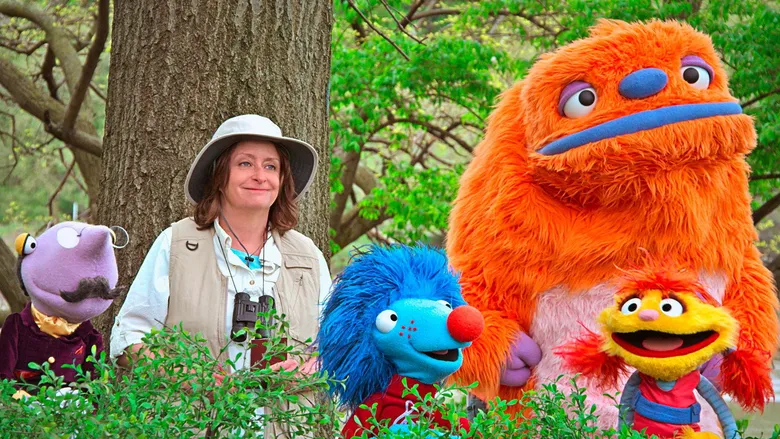
This episode keeps both feet firmly in the real world. Colorful helper characters guide the story, but the astronaut, the fruit seller, Pete, and his father are all real people in a real city, and the whole plot turns on everyday skills like following directions and finding a house on a map. There is no villain and no scary conflict, just a friendly team solving a birthday delivery step by step. For a young child this balance of familiar, real-life problem-solving with a few friendly characters is an easy and natural fit.
This score shows how enjoyable the series is for parents watching along. Scale: Tedious → Tolerable → Pleasant → Enjoyable.
This one holds up well for the grown-up on the couch. The plan-and-solve story has a clear goal and a satisfying payoff, the puppets and location filming look genuinely polished, and characters like the fussy, big-word Mr. Prim slip in the odd wink for adults. The main thing to sit with is the very saturated palette and the constant high-energy ensemble, along with song refrains that come back often, which can wear a little across a full sitting.
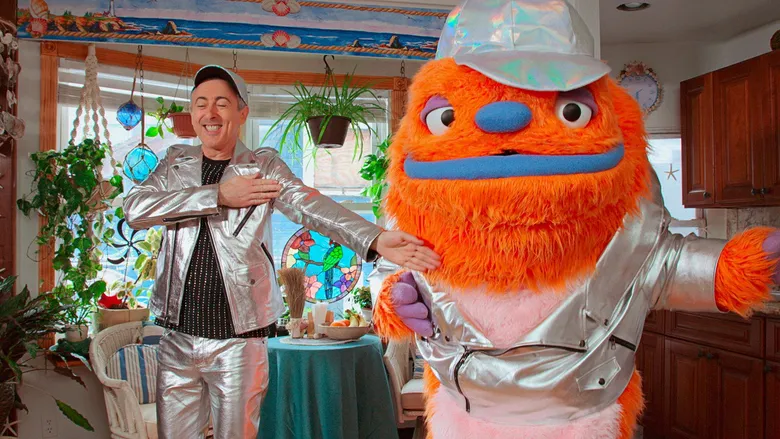
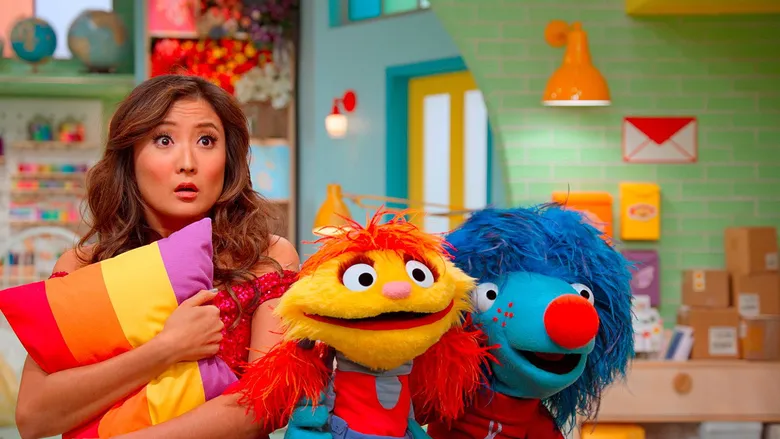
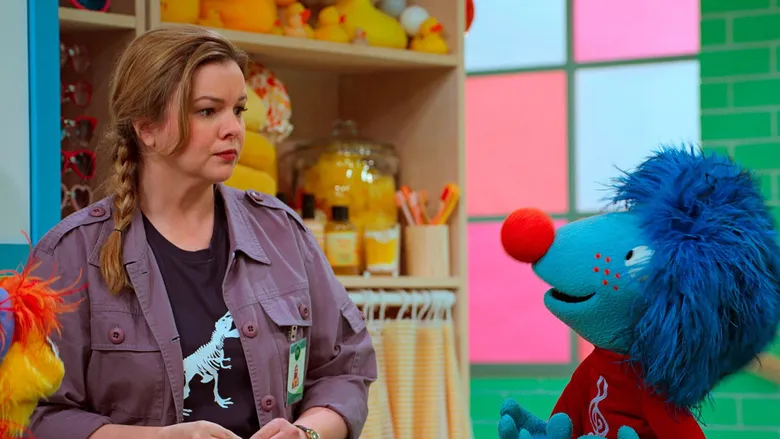
The Helpsters, a team of puppets who run a problem-solving help shop, are asked by astronaut Amrita to deliver a birthday present to her friend Pete before she launches to the moon. They make a plan with four jobs, find out that Pete lives in a red house near the park, read a map, and give step-by-step directions to reach his door. Along the way they travel through a real city and ask neighbours for help. When they arrive, Pete opens the box to find a party, and the group celebrates completing their plan.