




















This program is well-balanced. It remains mostly easy to follow and process. It is a good fit for the recommended age.
The pacing is moderate. The story remains easy for a child to follow.
The sound is soft and supportive.
The visuals are busy, with a lot of movement and frequent changes.
The episode holds one clear thread from start to finish: Sid wants to know how many seashells are in his jar, and every segment circles back to that question. Ideas arrive in a sensible order, from not knowing how to guess, to learning the estimation method at school, to trying it out at the dinner table. New information comes one piece at a time and is repeated often, so a child can follow each step without getting lost. The recurring segment format adds a few stops and starts, but each new block is clearly signposted.
The emotional tone stays warm and steady throughout. Adults and children treat each other with respect: Teacher Susie reassures Sid that 'there are no wrong answers when you think first', and Gerald is sincerely thanked for helping carry the jar. Worries stay small and are settled quickly, and the one mock-scary joke about bears in a cave is laughed off the moment it lands. Children are encouraged rather than corrected, and nobody is put down.
Sid drives his own investigation: he poses the question, runs a survey of his friends and family, and keeps testing his idea until it makes sense to him. The estimation method is shown as a clear chain of thinking, look closely from every side, count out ten, picture how many groups of ten there might be, write down a guess, then count to check. Sid estimates twenty-two shells and finds twenty-eight, while Gabriela guesses fifteen rocks and counts sixteen, so the gap between guess and answer becomes part of the learning. Trying, checking and adjusting are all visible on screen.
Language is clear and well matched to this age. A new word, 'estimation', is introduced, defined and repeated often enough to stick, and ideas like observing closely or counting in groups of ten are spelled out in plain terms. Sid mostly speaks in complete sentences, with the occasional excited 'wow' or 'cool' along the way. Big number words such as million and billion turn up in a song, framed playfully so they spark curiosity rather than confuse.
The estimation skill connects straight to everyday life, and the episode keeps tying it to real objects: pieces of cereal, meatballs at dinner, a jar of jelly beans, rocks and shells. A live-action stretch shows real children counting and guessing, making the activity easy to copy at home. The settings are familiar, a kitchen, a classroom, a car ride and a family dinner, with recognizable family and friendship moments. A brief flight of fancy about collecting all the stars in a giant jar is clearly marked as imagination.
More information
This score shows how inclusively the series portrays diverse people, families and cultures. Scale: Limited → Varied → Rich → Inclusive.
This science series follows Sid through his home and preschool with a steady group of friends and a three-generation family, so different ages, an extended household and a mix of backgrounds are simply part of his world. The friends are set apart through hair, glasses and names like Gabriela, May and Gerald rather than through skin colour, which the stylised art leaves invisible. Tasks and know-how are shared widely: the teacher runs the class, the father cooks the family dinner, and the grandmother turns out to be the savviest guesser, while the children all join in. The story still revolves around Sid himself, with the girls in lighter supporting parts, but the overall picture is varied and free of fixed clichés.
This score shows whether the series stays close to everyday reality or leans into fantasy. Scale: Fantasy → Mixed reality → Realistic.
This episode stays close to a child's real world: home breakfasts, a school classroom, a playground, and a family dinner at the end, all built around the everyday idea of guessing how many things fit in a jar. There is no villain and no real conflict between characters, so the learning grows out of questions rather than opponents. A few imaginative moments, like Sid pretending to sell special 'guess better glasses' or daydreaming about flying up to gather all the stars, are clearly framed as play and keep their own logic. The grounded setting and the light, easy-to-follow imagination are well matched for this age.
This score shows how enjoyable the series is for parents watching along. Scale: Tedious → Tolerable → Pleasant → Enjoyable.
Sid the Science Kid holds up well for a parent sharing the couch. The production is polished and a single estimation question gives the episode a clear thread, while gentle bits like Sid's salesman act and his stand-up opening offer the occasional grown-up wink. It stays firmly child-pitched and leans hard on repeating one idea, but the warm voices and clean songs keep it easy to have on in the room.
Themes
Science
Central
Teacher Susie frames estimation as 'something scientists do all the time' and the class runs an estimation investigation.
Numbers
Central
Sid counts out ten shells, estimates twenty-two and counts twenty-eight, and the class counts balls up to twenty-five.
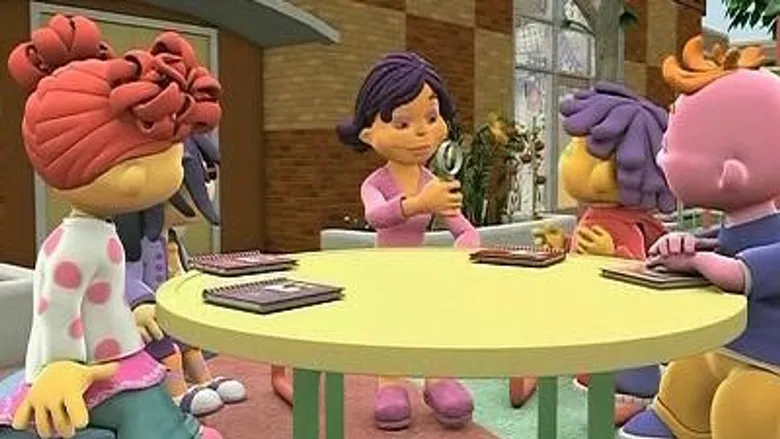
Sid brings home a school jar filled with seashells and wants to know exactly how many there are, but there are too many to count easily. Through a survey of his friends and a classroom investigation with Teacher Susie, he learns to estimate by counting out ten, picturing groups of ten and then guessing. He practices the method at home, comparing his guess of twenty-two shells to the actual twenty-eight, and tries it again at dinner with his family. The episode ends with Sid waving goodbye and imagining estimating the stars in the sky.