









This program is well-balanced. It remains mostly easy to follow and process. It is a good fit for the recommended age.
The pacing is fast. Images follow each other quickly, leaving little time to pause and take in what is happening.
The sound is clearly present and regularly draws attention.
The visuals are calm and well-organized.
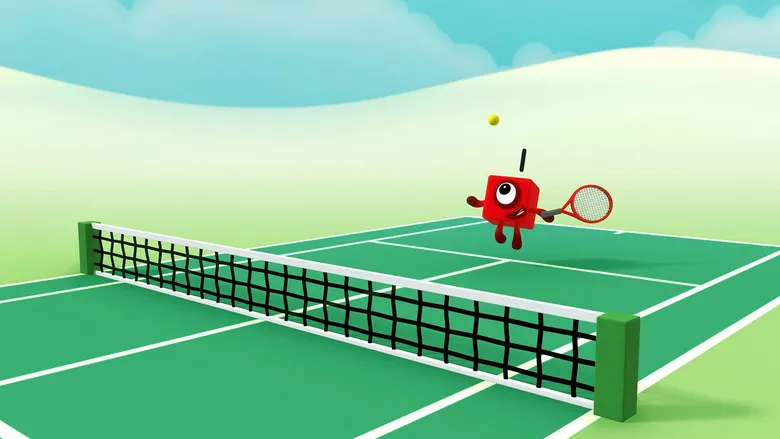
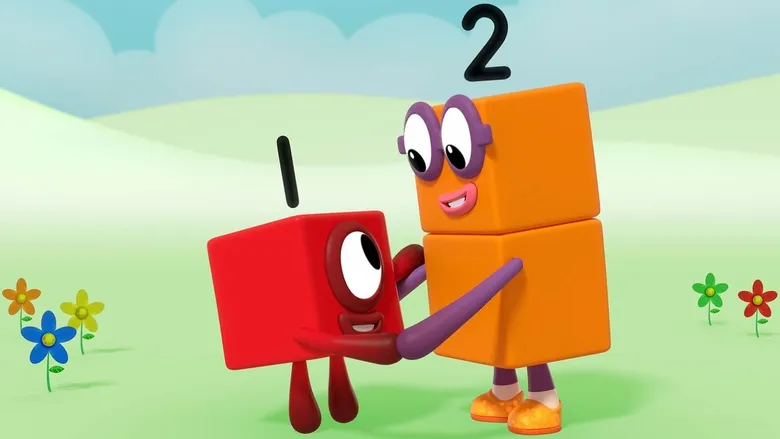
One story runs from start to finish: One wants to play tennis, cannot do it alone, finds a magic mirror, meets another One, and together they become Two. Events build sequentially, with the racket, the ball, and the net introduced one item at a time before play begins. New information arrives at a manageable pace for a toddler, usually one concept per scene. Cause and effect is made explicit, both verbally ('one plus one equals two') and visually when the two blocks physically join.
Interactions are warm and predictable throughout. When the second One appears, the first says 'Hello friend, I am so happy to meet you' and the response is equally kind. The single dip in mood, where One sighs 'there's not much fun with one', is resolved within the same scene as the friend arrives. Emotional shifts are gradual, with no abrupt switches between extremes and no shouting, mocking, or sarcasm between characters.
One identifies the problem ('How do I hit the ball back? We've only got one racket'), tries an attempted fix by running quickly between sides, recognises that does not work, and proposes the magic mirror as a new idea. The thinking process is visible step by step and the character drives each move rather than being rescued. The closing math ('one plus one equals two') links the reasoning directly to the practical outcome of being able to play together.
Sentences stay short and concrete, with words like 'tennis', 'racket', 'ball', 'friend', 'sun', 'plus', and 'equals'. The key phrase 'one plus one equals two' is repeated several times, each time reinforcing meaning rather than padding. Speech is clear and slow enough for a toddler to track, and the characters use words consistently across scenes (a racket stays a racket, a ball stays a ball).
The math content (counting to two, joining one and one to make two) has clear practical meaning and transfers directly to everyday counting with fingers or objects. Tennis itself is shown as a recognisable real-world activity, with racket, ball, and net set up in order. The pillar is held back because the world is heavily fantasy: talking number blocks, a magic mirror, and characters merging into one another. For a two-year-old still building a sense of how the real world works, that abstract setting limits how directly the social and physical patterns translate to daily life.
More information
This score shows how inclusively the series portrays diverse people, families and cultures. Scale: Limited → Varied → Rich → Inclusive.
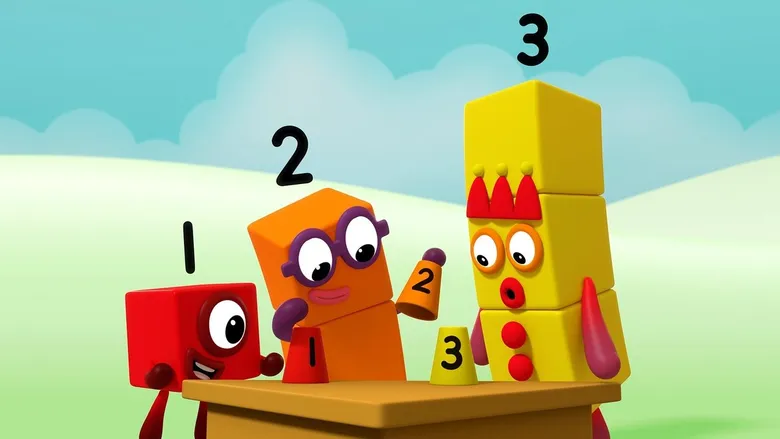
The cast is made up entirely of animated number blocks rather than human characters, so the usual markers of human diversity (ethnicity, family form, body, age) do not apply. Within that abstract world, this episode focuses on just two figures, One and Two, plus a duplicate One, and they share the story on equal footing. Both contribute ideas, both take initiative, and both join in the tennis play. The result is a narrow but balanced little ensemble that avoids stereotypical role splits without offering broader human representation.
This score shows whether the series stays close to everyday reality or leans into fantasy. Scale: Fantasy → Mixed reality → Realistic.
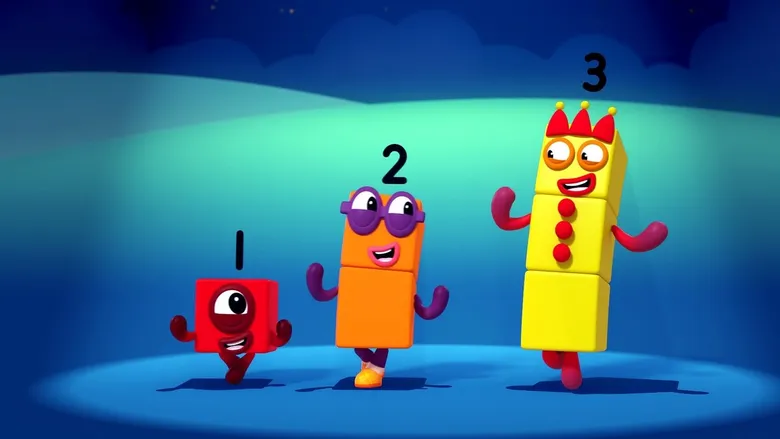
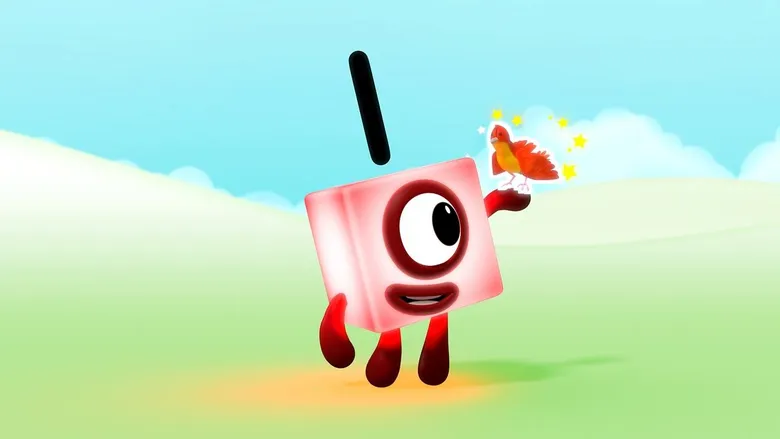
Numberblocks builds a fully imagined world where numbers are living red and pink characters with eyes and arms, set against pastel hills and a tennis court that floats in an abstract landscape. There is no villain at all: the only tension is loneliness ('there's not much fun with one') and a friendly puzzle about sharing a single racket, resolved through addition. The fantasy stays internally consistent because every transformation follows clear math rules (one plus one equals two), and a 'magic mirror' is used in a predictable way. For a 2-year-old the educational concepts land well, but the heavy reliance on anthropomorphic numbers and magic sits above the 'mostly realistic, light imagination' band suggested for this age.
This score shows how enjoyable the series is for parents watching along. Scale: Tedious → Tolerable → Pleasant → Enjoyable.
Numberblocks pairs polished BBC production craft with a small but real story arc: One is lonely, meets another one, and together they discover they can become Two. The humor is mostly pitched at the target preschool audience, with only the occasional 'anyone? someone? no one?' wordplay aimed slightly upward. Sound and palette are gentle on adult ears, and the math is presented with enough visual elegance that a co-viewing parent can appreciate the craft, even if there is little written for them.
Themes
Numbers
Central
The whole episode is built around the numbers one and two, with characters literally embodying those quantities.
Addition
Central
The equation 'one plus one equals two' is shown on screen and spoken aloud multiple times.
One, a small red block, wakes up in a sunny landscape and tries to play tennis but realises there is only one of him. After trying to run between both sides of the court, he discovers a magic mirror that lets another One appear. The two combine into Two, an orange block, and the story ends with the pair playing tennis together while the math '1 + 1 = 2' is reinforced through dialogue and on-screen text. The episode closes with end credits.