





This program is stimulating. It actively demands attention and can feel intense. For the recommended age, this may be on the more intense side.
The pacing is fast. Images follow each other quickly, leaving little time to pause and take in what is happening.
The sound is clearly present and regularly draws attention.
The visuals are well-balanced, with a clear overall view.
The episode keeps to one clear subject throughout, the number three, and builds in a sensible order: Three is formed when Two and One join, then shows what she can do, then a closing celebration. The maths is easy to follow, with blocks visibly combining to make three and one taken away to leave two. What holds this pillar back for a two-year-old is how much gets packed into the song: Three Blind Mice, Goldilocks, the Three Musketeers and 'three meals a day' all arrive close together, so a young child meets many new ideas in one stretch. Most of those references will pass a toddler by.
Emotionally the episode feels safe and friendly. There is no fear, anger or sadness, and the few small hitches, like the juggling balls vanishing or Three saying 'oh no I've broken through', are smoothed over at once with the reassurance 'everything's going to be all right'. The character stays consistent and good-natured the whole way through. What keeps this pillar from scoring higher is the constantly high, showy excitement and the repeated 'look at me' framing, which holds a child at a heightened pitch rather than showing how to settle down.
Three shows plenty of initiative, choosing her own tricks and leading every activity herself, and there is a warm encouragement to keep going: 'you should try and try and try again, that's my advice.' One genuine piece of problem-solving stands out, when she counts to three to build a shape with three sides and names it a triangle. The limitation is that most of the episode demonstrates answers rather than working them out, so there is little visible trying, getting stuck and adjusting. A child mostly sees the result rather than the thinking behind it.
There is a good amount of clear, useful language for learning to count, with 'one, two, three' repeated often and simple lines like 'a shape that's got three sides.' Number words are used correctly and consistently. Holding the pillar back for a two-year-old is the grown-up vocabulary threaded through the song, names like the Three Musketeers and Three Blind Mice and words like 'funky melody' and 'entertain' that sit above a toddler's understanding. A lot of the wording serves the performance rather than plainly explaining, so the meaning is patchier than the counting alone would suggest.
The counting practice has real value a child can carry off the screen, joining in with 'one, two, three', spotting the number three and recognising a triangle by its three sides. Against that, the world itself is made entirely of talking number-blocks performing on a stage, which is a long way from a two-year-old's everyday life. There are few recognisable everyday situations or relationships to connect to, and the fairy-tale names are mentioned rather than shown. The learning is useful, but it sits inside an abstract, made-up setting rather than the real world.
More information
This score shows how inclusively the series portrays diverse people, families and cultures. Scale: Limited → Varied → Rich → Inclusive.
This episode features only animated number-block characters made of stacked colored cubes, so traditional dimensions of human representation (ethnicity, family form, culture, body and age diversity) are not part of the world shown on screen. The lead character Three is feminine-coded and takes a confident, performing role, which works against a passive-female pattern. The cast of numbers cooperates as audience and helpers without hierarchy. Parents looking for visibly diverse human characters will not find them here, but the show also does not reinforce stereotypes about real-world groups.
This score shows whether the series stays close to everyday reality or leans into fantasy. Scale: Fantasy → Mixed reality → Realistic.
This episode lives entirely in an abstract fantasy world where numbers are personified as talking, juggling, dancing blocks. There is no villain at all, the only 'conflict' is the friendly challenge of learning to count to three. The fantasy follows its own clear logic: each character's block count matches their numeric value, and one plus one plus one really does make three on screen. For a 2-year-old who tolerates only light imagination, this fully imagined world sits on the fantastical side of the age band.
This score shows how enjoyable the series is for parents watching along. Scale: Tedious → Tolerable → Pleasant → Enjoyable.
Numberblocks works as a backdrop for an adult co-viewer thanks to its cultural callouts to nursery rhymes and fairy tales, and the production craft is genuinely strong. The musical refrain repeats several times within four minutes, which becomes the main irritant for anyone in the room. The story is a thin showcase built around the number three, not a real plot, but the magician framing gives it personality. Overall a watchable presence for adults with one repetitive song.
Themes
Numbers
Central
The whole episode is built around the number three, counting 'one, two, three' over and over
Math
Central
Blocks visibly combine to show 2 + 1 = 3 and one is taken away to show 3 - 1 = 2
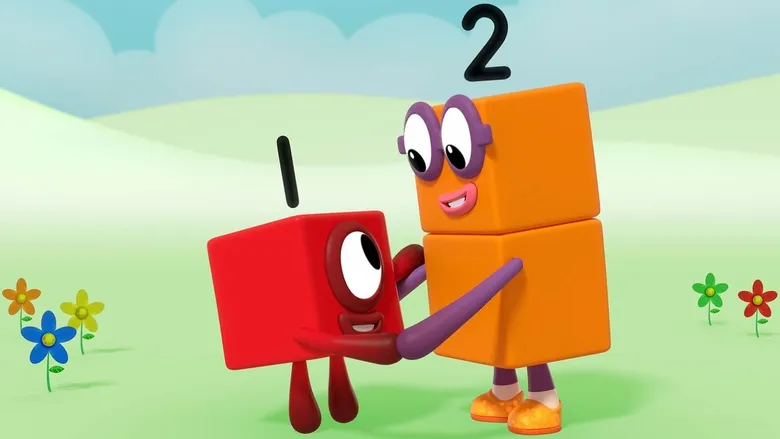
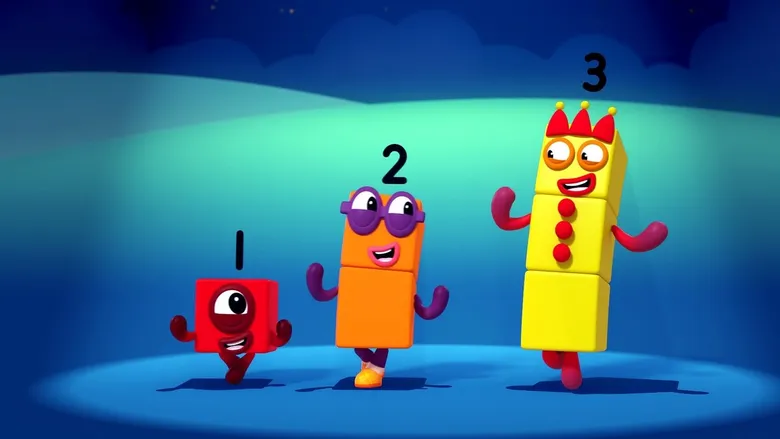
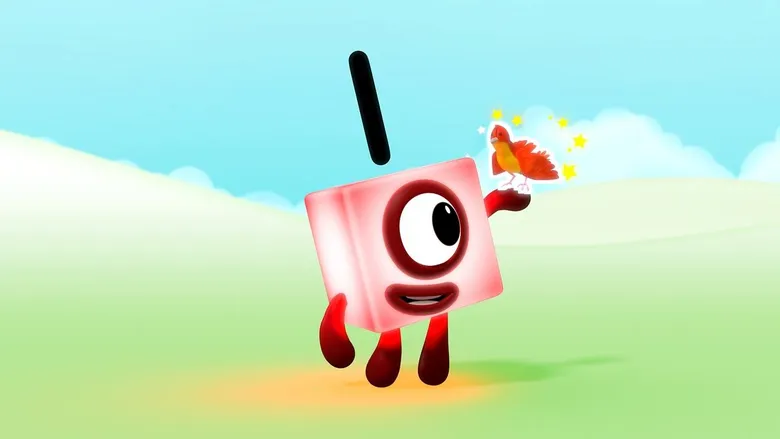
Three, a yellow block character with a small crown, is created when the Numberblocks Two and One join together to make 2 + 1 = 3. She then launches into a song-and-dance show, juggling three balls, taking one away and adding it back, and pointing out all the things that come in threes, from the Three Little Pigs to a triangle's three sides. The action plays out on a bright animated stage with spotlights, curtains and a starry backdrop. It ends with a dancing finale and fireworks before the closing credits.