














This program is highly stimulating. It may be difficult to calmly process everything. For the recommended age, this can feel clearly intense.
The pacing is fast. Images follow each other quickly, leaving little time to pause and take in what is happening.
The sound is intense and continuously present.
The visuals are busy, with a lot of movement and frequent changes.
The video loosely circles one idea, a family beach day where a toy needs to be freed from the sand, but it plays out as a series of loosely linked play moments rather than a clear beginning, middle and end. New toys and animated characters keep arriving, so the connecting thread is easy to lose. Many events resolve through magical, computer-generated help instead of a consequence the child can predict. For a three-year-old it is hard to hold on to what links one moment to the next.
The tone is mostly cheerful and caring. Characters ask for help, answer with 'thank you' and 'don't worry', and comfort each other, and a worried 'oh no, what happened' moment is followed before long by reassurance and a celebration. What holds this pillar back is that the emotional register keeps shifting between high excitement, a brief 'it's mine, no it's mine' squabble and loud cheering, so the overall energy stays keyed-up rather than settling. For a three-year-old that steady high arousal can be more stirring than soothing.
When a problem appears, such as a toy stuck in the sand or a character calling for help, it is usually resolved in a single step or through magical computer-generated assistance. There is little visible trying, checking and adjusting, so the thinking that leads to a solution is mostly skipped. The children do show some initiative when they choose to help, which keeps this from scoring lower. Even so, a three-year-old mainly sees results appear rather than a problem being worked through.
The spoken words are short and concrete, which in principle suits a three-year-old, but much of the talk is fragmented and hard to follow. A large share is made up of exclamations like 'wow', 'huh', 'yay' and 'yahoo' rather than full sentences that carry information. Some phrases, such as 'it's my choke' and 'we need some special', are incomplete or unclear. There is little steady, meaningful language here for a child to pick up new words from.
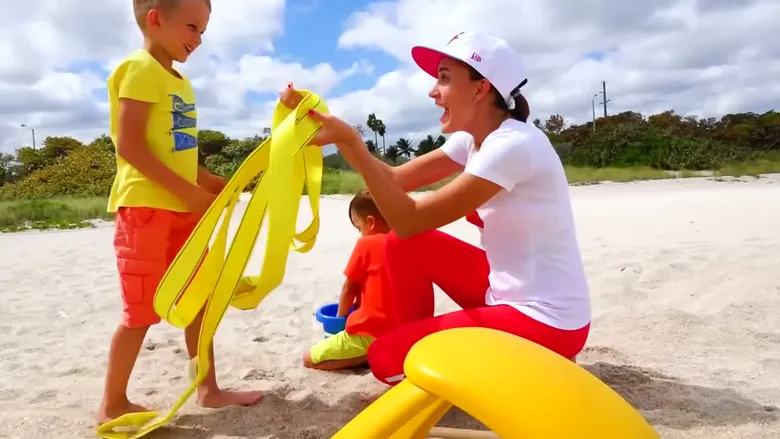
The video does show real, recognizable situations: a mother and her children at the beach, digging in the sand, riding toy diggers and helping one another, all things a child could copy at home. The family outing itself is familiar and easy to relate to. What holds this pillar down is that much of the action is layered with computer-generated talking toys and magical helpers, so a large part of what happens cannot be repeated in real life. The genuinely useful play sits alongside a lot of fantasy.
More information
This score shows how inclusively the series portrays diverse people, families and cultures. Scale: Limited → Varied → Rich → Inclusive.
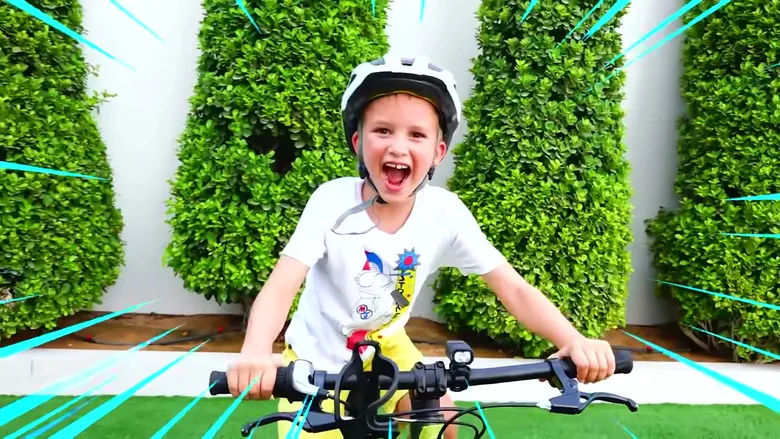
This live-action video follows one family, a mother and her two young sons, playing with bright toys on a beach by the sea. The cast is small and everyone looks alike, so the overall picture of who exists in the world is narrow, with no variation in background, body type, or family form. Within that small group the behaviour is handled fairly evenly: the mother joins in actively and even takes the construction-worker part, while the children lead the play and work together to free a toy from the sand. The main limitation is the lack of breadth in who is shown, more than the way the characters behave.
This score shows whether the series stays close to everyday reality or leans into fantasy. Scale: Fantasy → Mixed reality → Realistic.
This is live-action footage of two young brothers playing on a real beach, so the world stays close to everyday life. Sand, sea, buckets, a yellow ride-on digger, and sharing a snack anchor the show, with the one imaginative touch being beach toys that have cartoon faces and come to life. There is no villain and no good-versus-evil storyline; the only friction is a brief squabble over a snack and a playful rescue when a toy calls for help. For a 3-year-old this realism-led mix with a light sprinkle of fantasy fits well, with the constant animated faces being the main imaginative layer to keep in mind.
This score shows how enjoyable the series is for parents watching along. Scale: Tedious → Tolerable → Pleasant → Enjoyable.
This beach episode offers little for an adult sharing the room. The talk stays at simple exclamations like 'it's mine, no it's mine' and 'help me', with no jokes or layers aimed at a grown-up, and the story is a loose string of toy play rather than a plot to follow. The clashing bright palette and constant excited squealing make it tiring to have on in the background. The camera work and sunny beach footage are clean and well shot, which is the strongest part of the production, though the added voices sit awkwardly over the action.
Themes
Pretend play
Central
Animated toy characters with cartoon faces, including a yellow digger called 'Helpy', join the children's beach play as if alive.
Beach
Central
The entire video takes place on a sandy beach beside the sea.
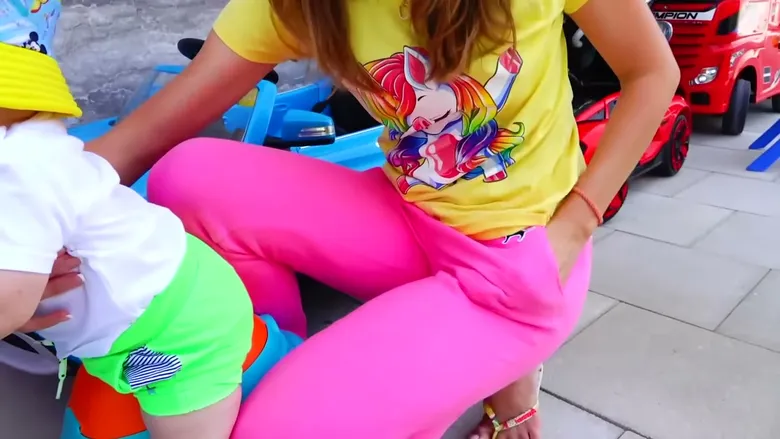
Two young brothers and their mother spend the video playing on a sandy beach beside the sea. Bright computer-generated toy characters, including a yellow toy digger, come to life and join the play. When a toy gets stuck in the sand and a character calls for help, everyone works together to pull it free. The video ends with cheering and applause, followed by a full-screen 'Subscribe' card.