













This program is highly stimulating. It may be difficult to calmly process everything. For the recommended age, this can feel clearly intense.
The pacing is fast. Images follow each other quickly, leaving little time to pause and take in what is happening.
The sound is intense and continuously present.
The visuals are well-balanced, with a clear overall view.
The story is easy to follow. A single thread runs through the whole video: a mother duck whose ducklings go off and return one fewer each time, until they all come back together at the end. The countdown structure gives a clear beginning, middle and end, and each verse adds only one small change, so the child is never loaded with too much new information at once. The small caveat is that why the ducklings leave and why they return is never really explained, so the cause and effect behind the story stays loose.
The emotional tone stays warm and steady. The mother duck calls for her ducklings with care, and the only dip comes when she grows sad that they have not returned. That worry is resolved at the end when all five ducklings come back to her, giving the child a reassuring, happy reunion. The one caveat is that the sadness builds gradually across several verses before it is resolved, so the comforting payoff arrives only in the final moments.
This pillar scores low because the video shows almost no real thinking or problem-solving. The mother duck's only response to her missing ducklings is to call out 'quack, quack, quack', and the ducklings simply reappear without any visible effort, plan or steps in between. There is no trying, checking or adjusting that a child could learn from. The resolution happens on its own rather than through a character working something out.
The language fits a young child well. Sentences are short, concrete and built on rhythm and repetition, with familiar words like 'mother', 'duck', 'hill' and 'day', plus counting from five down to one. Because the same lines return every verse, a child can quickly join in and predict what comes next. The main limitation is that a large share of the words is the repeated 'quack, quack, quack' refrain, which carries sound and rhythm more than new meaning.
The clearest real-world value is counting: the numerals from five down to one appear on screen as the ducklings are tallied, which a child can connect to everyday counting. Beyond that there is little to carry into daily life, because the action is mostly stylised ducks swimming and dancing rather than recognisable everyday tasks. The mother-and-ducklings reunion does mirror a familiar family bond of separation and coming back together. What holds this pillar down is that the ducks are heavily cartoon-like and the activities are decorative rather than practical things to try off-screen.
More information
This score shows how inclusively the series portrays diverse people, families and cultures. Scale: Limited → Varied → Rich → Inclusive.
This is a nursery rhyme acted out almost entirely by ducks, so there is little chance to show different people, cultures or ways of living together. The cast is one mother duck and her five look-alike ducklings, a single caregiving bond with no other family forms or human variety inside the story. The mother is a warm and capable lead who solves the problem of her missing babies, which is a genuine plus, but her part stays purely maternal and leans on familiar feminine styling. Two children of different skin tones appear only on the closing subscribe screen, a small inclusive signal that sits in the branding rather than the story.
This score shows whether the series stays close to everyday reality or leans into fantasy. Scale: Fantasy → Mixed reality → Realistic.
This nursery rhyme stays close to a world your child already knows: yellow ducks swimming on a pond, green rolling hills, and a mother duck calling her ducklings home. The only imaginative touch is that the ducks show human-like feelings, which sits comfortably within what a child of this age expects. There is no villain anywhere; the gentle tension comes only from the ducklings wandering off and the mother's worry, which resolves when all five return at the end. The realistic setting with a light sprinkle of imagination is a strong fit for this age.
This score shows how enjoyable the series is for parents watching along. Scale: Tedious → Tolerable → Pleasant → Enjoyable.
This is a single counting song made for very young children, and for the most part it sits in the room as bearable background for an adult. The 3D animation is clean and the ducks are expressive, but there is nothing layered for a grown-up to catch, and the verse repeats the same melody and the 'quack quack quack' line many times over. A small story does hold it together, the mother duck grows sad as her ducklings stay away and brightens when all five return. For a co-viewing parent it is tolerable rather than rewarding, with the looping refrain and very saturated colours as the main drawbacks.
Themes
Counting
Central
Numerals from five down to one appear on screen as the ducklings are counted each verse.
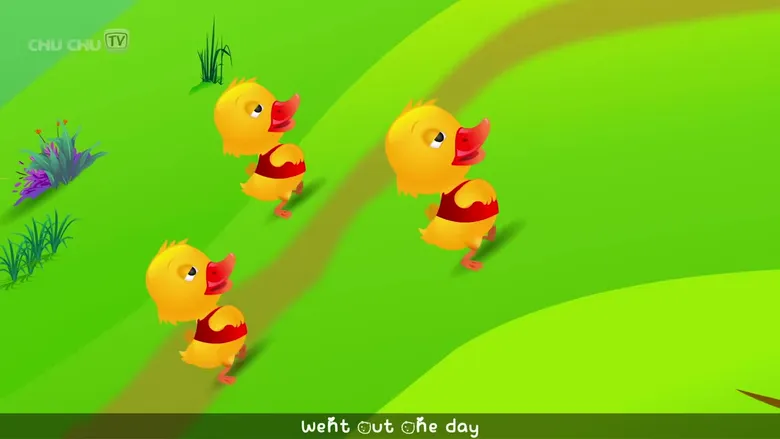
A mother duck and her five ducklings star in this animated version of the nursery rhyme 'Five Little Ducks'. Across a grassy, pond-filled outdoor setting the ducklings go out to play and return one fewer at a time while the mother calls 'quack, quack, quack', with the matching number shown on screen each verse. When none of the ducklings come back the mother duck grows sad and calls once more, and all five return to her. The video opens on the ChuChu TV logo and closes on a signpost asking viewers to subscribe.