











This program is highly stimulating. It may be difficult to calmly process everything. For the recommended age, this can feel clearly intense.
The pacing is fast. Images follow each other quickly, leaving little time to pause and take in what is happening.
The sound is intense and continuously present.
The visuals are busy, with a lot of movement and frequent changes.
The episode is easy to follow because one idea runs through it: doing everyday self-care. The trade-off is that there is no real story, only a list of separate actions (brush teeth, wash face, comb hair, eat, drink) strung together by the song, so there is no beginning, middle or end to anchor a child. Each verse stays simple and adds very little new information at once, which keeps it digestible for a three-year-old. What is missing is clear cause and effect: the routines are shown but the video rarely connects an action to its result.
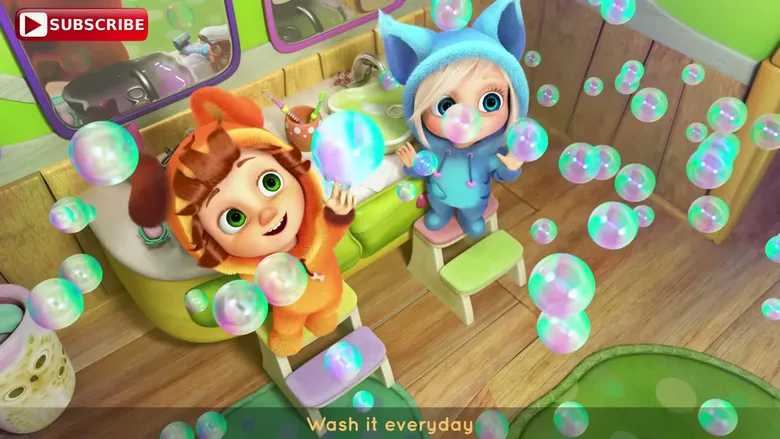
The emotional tone is warm and steady throughout, with smiling children playing happily together as they brush and wash. Nothing frightening or upsetting happens and the friendly mood holds from start to finish, so a young child is never caught off guard by a sudden change of feeling. The two characters treat each other kindly, sharing the bathroom mirror and blowing bubbles side by side without teasing or conflict. The one small caveat is that the cheerful intensity stays at a single bright level, with little emotional light and shade.
There is nothing for the children to figure out: the song demonstrates finished routines rather than showing a problem, an attempt and a result. The characters simply perform each action on cue, so a child sees no thinking, trying or adjusting, and no choices made by the characters themselves. Every activity is a single quick action with no steps to reason through. As a model for working something out independently, the episode offers very little.
The language fits a three-year-old well: short, clear instructions in concrete words like 'brush your teeth,' 'wash your face' and 'comb your hair,' sung slowly enough that every word lands. The repetition reinforces the meaning and gives a child time to join in, and the words are used correctly and consistently. The small caveat is the endless chant of 'properly, properly, properly,' which fills a large share of the lyrics without adding much and leans on loose fragments rather than full sentences. Overall the words are clean, purposeful and easy to understand.
Everything the children do maps directly onto real daily life: brushing teeth, washing a face, combing hair, eating and drinking milk are all things a child can copy at home with familiar objects. The bathroom and home setting is recognizable, and the animal costumes and bubble play are light touches of imagination that do not get in the way. The limitation is that each habit is shown as a single happy action rather than broken into clear steps, so a child sees what to do more than how to do it. The social side stays thin too, with the focus on the routines themselves rather than on the relationship between the children.
More information
This score shows how inclusively the series portrays diverse people, families and cultures. Scale: Limited → Varied → Rich → Inclusive.
This is a short song video built around two toddlers, Dave and Ava, who move through daily self-care routines together with a few animal friends. Both leads are light-skinned, and the action stays inside one home, which keeps the world small, though an adult woman with brown skin appears as a caregiver and adds a touch of ethnic variety. The boy and girl share every activity equally, so nothing is split along gender lines between them. The main limitation is breadth: one home, one caregiver in a traditional serving role, and little sense of the wider range of people and ways of living.
This score shows whether the series stays close to everyday reality or leans into fantasy. Scale: Fantasy → Mixed reality → Realistic.
This is a music video that walks through everyday self-care routines: brushing teeth, washing your face, combing your hair, eating and drinking milk. Dave and Ava and a handful of friendly cartoon animals act out each task in a normal bathroom and kitchen, so almost everything on screen is something a young child does at home. There is no villain and no conflict, just gentle repetition set to song. The light imaginative touches, dancing animals and a smiling sun, stay consistent and sit comfortably within what a child this age recognizes.
This score shows how enjoyable the series is for parents watching along. Scale: Tedious → Tolerable → Pleasant → Enjoyable.
For a parent in the room, this offers little beyond a clean, well-made surface. The animation is bright and professionally produced, but the song loops one melody and the word 'properly' over and over, with each verse only swapping a single daily activity. There is no story to follow and nothing pitched at an adult, so the main draw is the polished craft rather than the content. The constant refrain and high-saturation visuals wear thin on repeat viewing.
Themes
Healthy habits
Central
The whole song cycles through daily self-care: 'brush your teeth,' 'wash your face,' 'comb your hair,' 'eat your food,' 'drink your milk.'
Personal hygiene
Central
Ava and Dave brush their teeth with toothbrushes and wash their faces with foam at a bathroom sink.
Dave and Ava, two toddlers dressed in animal onesies, sing a good-habits song in a bright bathroom and home setting. Across the verses they demonstrate brushing their teeth, washing their faces, combing their hair, eating their food and drinking their milk, each repeated with the refrain to do it 'properly' and 'every day.' The mood stays cheerful and playful, with bubbles and dancing between verses. It ends with the characters facing the camera as a voice thanks viewers and invites them to subscribe and download the app.