










This program is highly stimulating. It may be difficult to calmly process everything. For the recommended age, this can feel clearly intense.
The pacing is fast. Images follow each other quickly, leaving little time to pause and take in what is happening.
The sound is intense and continuously present.
The visuals are busy, with a lot of movement and frequent changes.
The video is easy to follow because it sticks to one simple idea: counting buses from one to ten. New information arrives in small amounts and is repeated often, so a toddler is never asked to track many things at once. What holds this pillar back is the absence of a real story. Events do not build on each other toward a beginning, middle and end, and one action rarely leads clearly to the next, so there is little cause-and-effect to follow beyond the rising count.
Emotionally this is a safe watch. The mood stays warm and cheerful from start to finish, with smiling buses, no scary moments, no tension and no sudden swings in feeling, so there is nothing upsetting a child would need to recover from. The small caveat is that the buses barely interact with one another, so there is little modelling of kindness, support or attunement between characters for a child to absorb.
This pillar scores very low because the video contains no problem to solve and no thinking process to watch. The buses are counted and driven around, but no character sets a goal, tries something, hits a setback or works out an answer. There is no initiative and no step-by-step reasoning a child could pick up and copy. The content is a counting song rather than a story about figuring something out.
The language fits a two-year-old well. The words are concrete and familiar, such as the numbers one to ten and 'buses', and the clear, sung repetition helps them stick. Counting in order gives the words a real purpose instead of empty filler. The one limitation is how narrow the language is: it is almost entirely counting, with very few complete sentences, so there is little new vocabulary or sentence structure for a child to grow into.
This pillar is held back by how little of the video carries over into real life. Counting to ten is a genuinely useful skill a child can practise off screen, and the city, roads and shops are recognisable from daily life. But the buses have faces and drive themselves, which is make-believe rather than something a toddler can imitate, and most of the on-screen action is decorative driving and parking with no clear purpose. There is also little real social interaction, since the buses do not relate to each other in ways a child would recognise from family or play.
More information
This score shows how inclusively the series portrays diverse people, families and cultures. Scale: Limited → Varied → Rich → Inclusive.
This is a counting song performed entirely by smiling cartoon buses in a busy city, with no human characters at any point. As a result it offers almost no representation of real people or the different ways families and communities live, and the only variety on screen is the colour and shape of the vehicles. On the positive side, the buses are treated as equals and the video avoids gender or cultural stereotypes, since every bus simply drives and gets counted in turn. For a short, repetitive number song this is a neutral picture rather than a broad or inclusive one.
This score shows whether the series stays close to everyday reality or leans into fantasy. Scale: Fantasy → Mixed reality → Realistic.
This is a calm, recognizable world built around buses, a city, and counting, all things a small child meets in everyday life. There is no villain and no conflict at all, just buses lining up to be counted and driving around town, which suits this age well. The one imaginative touch, buses with friendly faces and smiling stars, stays light and consistent throughout. The small caveat is that those living vehicles are the central characters, so the show leans a little more on imagination than a purely realistic program would.
This score shows how enjoyable the series is for parents watching along. Scale: Tedious → Tolerable → Pleasant → Enjoyable.
This song offers little for an adult sharing the room. The counting refrain repeats with no jokes, references, or story for a grown-up to follow, and nothing develops beyond buses driving around a bright city. The repeated 'One little, two little, three little buses' line is the main source of fatigue on replay. The clean 3D animation is the one real strength, with consistent character design and a polished, colorful look.
Themes
Counting
Central
The sung lyrics count buses from 'one little, two little, three little buses' up to 'ten little buses', repeated several times.
Vehicles
Central
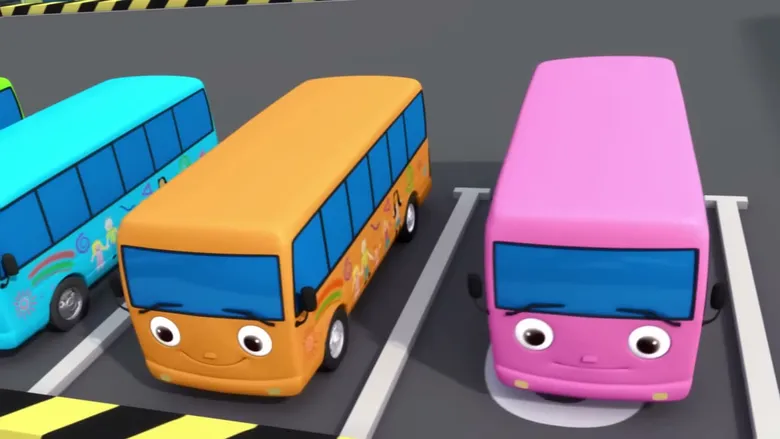
Brightly coloured cartoon buses are the only characters and fill nearly every shot, driving and parking.
This is a sung nursery rhyme from Little Baby Bum that counts a fleet of brightly coloured cartoon buses from one to ten. Each bus is a different colour with eyes on the windshield and a smiling mouth, and they drive and park around a cartoon city of skyscrapers, roads and shops while the counting verse repeats several times. Near the end a short 'This Little Piggy' verse begins as a closing screen appears. The video finishes on an end card with a 'Subscribe' button, links to other videos and the Little Baby Bum website.