









This program is stimulating. It actively demands attention and can feel intense. For the recommended age, this may be on the more intense side.
The pacing is moderate. The story remains easy for a child to follow.
The sound is intense and continuously present.
The visuals are busy, with a lot of movement and frequent changes.
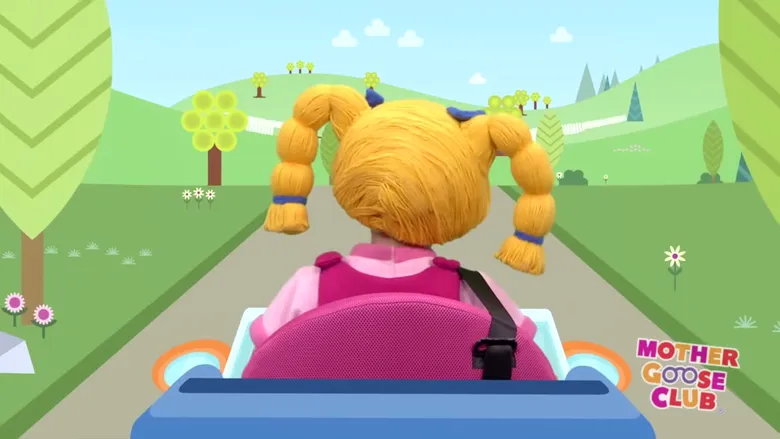
One simple thread carries the whole episode: a girl sets off in her car and travels toward the park. New ideas are introduced sparingly and the heavy repetition of the refrain keeps everything easy to follow for a young child. The small caveat is that the journey is built more from repeated verses than from a clear build toward an ending, so the sense of progress stays loose. Moments like turning the handlebar and stopping for a hopping toad give light, predictable cause and effect.
The mood stays cheerful and even throughout, with no anger, fear or sadness for a child to manage. The girl smiles as she drives, the voices are friendly, and there is nothing startling to absorb. A faint line about hurrying before it gets dark adds the smallest hint of urgency, and it resolves into simply arriving, so any tension settles at once. The one modest limit is that the warmth comes mostly from a solo character rather than from real interaction between people.
There is almost no problem for the girl to work through, so a child sees little trying, figuring out or learning from mistakes. The drive simply unfolds, and choices like stopping for a toad happen in a single beat with no visible thinking behind them. She does set off on her own initiative, which gives a small sense of self-direction, but there are no steps of attempt and adjustment to follow. As a result the episode offers little to model how to solve things independently.
The words are short, concrete and rhyming, naming things a young child knows like the car, the park, a toad and the horn. The singing is clear and the on-screen words match what is sung, which supports understanding and joining in. Much of the language describes what is happening, though a fair share is playful filler such as 'vroom vroom' and 'beep beep' rather than meaning. The light caveat is that several lines are loose phrases rather than full sentences, which suits this young age well enough.
The episode connects to real life only in patches: buckling a safety belt before setting off is a genuinely useful habit, and the neighbourhood, park and bus stop are familiar everyday places. The clear limitation is that a small child driving a real car alone is make-believe rather than something to copy, so much of the action stays in pretend rather than practical doing. Pretend play and singing along are things a child can carry off the screen, which gives the content some real-world footing. Social life is thin, since the girl travels mostly alone with little relationship to others.
More information
This score shows how inclusively the series portrays diverse people, families and cultures. Scale: Limited → Varied → Rich → Inclusive.
This sing-along puts one child behind the wheel of a toy car for almost the entire song, with a small costumed cast joining in for the opening and a few dance breaks. There is some variety in skin tone across that group, but the overall picture stays narrow: everyone is a child, no families or adults appear, and the focus rests on a single performer. Roles are not stereotyped, and when the group dances it moves together as equals, yet with one lead carrying the whole song there is little spread of tasks or range of behaviour to see. The breadth of people and ways of living shown remains limited.
This score shows whether the series stays close to everyday reality or leans into fantasy. Scale: Fantasy → Mixed reality → Realistic.
This is a cheerful song about pretend driving, and it stays close to a young child's everyday world: a car, a seatbelt, streets, and a park. The framing is openly imaginative ('let's pretend we're driving'), with only light flourishes like feeling 'like a superstar' and passing a hop toad. There is no villain and no conflict, just a happy ride from day to dark, which fits a three-year-old well. The small amount of imagination stays consistent throughout the pretend-play frame.
This score shows how enjoyable the series is for parents watching along. Scale: Tedious → Tolerable → Pleasant → Enjoyable.
This is a single nursery-rhyme song built around pretending to drive a car, aimed squarely at young children with little for an adult to latch onto. The story is a thin journey that leans heavily on a repeated refrain, and that repetition, paired with a bright, saturated palette, can grow wearing for a grown-up in the room. The 2D animation is clean and competent and the sound mix is clear. Overall it does its job for a young audience but offers a parent mostly background company.
Themes
Vehicles
Central
A girl drives a bright orange toy car down the street for the entire song.
A young girl buckles her safety belt and sets off in a bright toy car, singing as she drives through a sunny neighbourhood toward the park. Along the way she bounces over a bumpy road, stops for a hopping toad and honks the horn while repeating the 'driving in my car' refrain. The song winds down as the trip ends, with a short rainy bus-stop scene closing the episode. On-screen lyrics invite children to sing along.