



























This program feels calm and predictable. It gives room to watch and process. For the recommended age, this may feel calm or somewhat slow.
The pacing is moderate. The story remains easy for a child to follow.
The sound is soft and supportive.
The visuals are calm and well-organized.
The story follows one clear thread from start to finish: Daniel and his friends plan a picnic, the rain ruins it, and they find a way to picnic indoors. New information arrives in small, manageable pieces, with each scene building on the last. Cause and effect are visible and easy to follow, like the squashed ball leading to a throwing game and the chime time revealing clocks shaped like a castle and a tiger, which then sparks the indoor-picnic idea. Information density stays modest, which fits a three-year-old listener.
Emotional shifts are gentle and always named out loud. When the ball is squashed and again when the rain hits, the children explicitly say they are disappointed, and Dad Tiger walks them through the familiar 'turn it around and find something good' refrain. Interactions stay warm and respectful across the episode, with no mocking, sarcasm, or shaming, and adult and child characters behave consistently. Every dip in mood is followed by an explicit, in-scene recovery moment, which is exactly what young viewers benefit from.
Problem-solving is modelled with visible steps: the children name the problem, an adult or peer asks an open prompt like 'what else could you do?', and a new idea is generated together. Daniel takes initiative when he proposes having the picnic inside among the clocks. The solutions usually run to two or three explicit steps, and cause-effect reasoning is shown plainly. The score is held back a little because most thinking is triggered by Dad Tiger's prompt rather than fully child-led, and the resolutions arrive quickly without much trial and adjustment.
Sentences are short, concrete, and clearly articulated: 'we're going to the park for a picnic', 'our ball is squish squash splat'. Vocabulary stays close to the child's daily world, with playful sound words like 'splat' and a repeated jingle that reinforces the lesson rather than padding the dialogue. A few stretch words such as 'royally' and 'disappointed' are introduced, but always supported by context and repetition. Language carries real information almost all of the time, with very few hollow exclamations.
Picnic preparation, packing a basket, playing ball, dealing with sudden rain, and finding a new plan are all recognisable from a child's everyday life, and the social dynamics around naming a feeling and handling it together transfer directly off-screen. The score is held back by the all-animal cast and the brief 'make believe' ant detour, which add a fantasy layer on top of an otherwise realistic story. For a three-year-old this lands as mostly applicable with a noticeable storybook framing, especially around the royal castle and the talking trolley.
More information
This score shows how inclusively the series portrays diverse people, families and cultures. Scale: Limited → Varied → Rich → Inclusive.
The episode features a small core cast of friends with some visible variation, most notably Miss Elaina as a recurring character with darker skin and Prince Wednesday representing a royal family structure. The closing live-action song sequence shows real children of different ethnicities and looks. Roles among the three friends are evenly shared, with Miss Elaina presented as the knowledgeable one about picnics, all three children allowed to express disappointment openly, and Daniel's dad shown as a warm working father at the clock factory.
This score shows whether the series stays close to everyday reality or leans into fantasy. Scale: Fantasy → Mixed reality → Realistic.
This episode mixes a stylized fantasy frame (talking tigers, a Prince Wednesday in a castle, a friendly trolley) with situations any toddler will recognize: going on a picnic, a ball getting squashed, rain spoiling outdoor plans, and learning to handle disappointment. There is no villain, and the conflict comes entirely from everyday hiccups rather than from any antagonist. The fantasy rules stay consistent throughout, and an explicit 'let's make believe' moment teaches children to mark imagination as imagination. For a 3 year old, the balance lands well: enough familiar daily life to relate to, with imagination kept gentle and clearly signposted.
This score shows how enjoyable the series is for parents watching along. Scale: Tedious → Tolerable → Pleasant → Enjoyable.
This episode works comfortably as background viewing for adults thanks to calm voices, gentle music, and a polished PBS production. The Mr. Rogers callbacks ('won't you be my neighbor', 'it's such a good feeling', 'because it's you I like') offer mild nostalgic appeal, though the humor and language stay firmly aimed at preschoolers. The picnic-then-rain plot is simple but coherent, and the repeated lesson 'when something seems bad, turn it around and find something good' is delivered in a soft, sing-song way rather than a grating one.
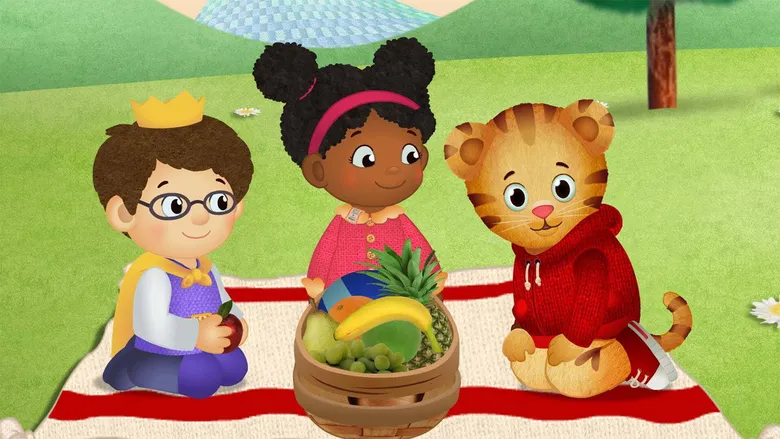
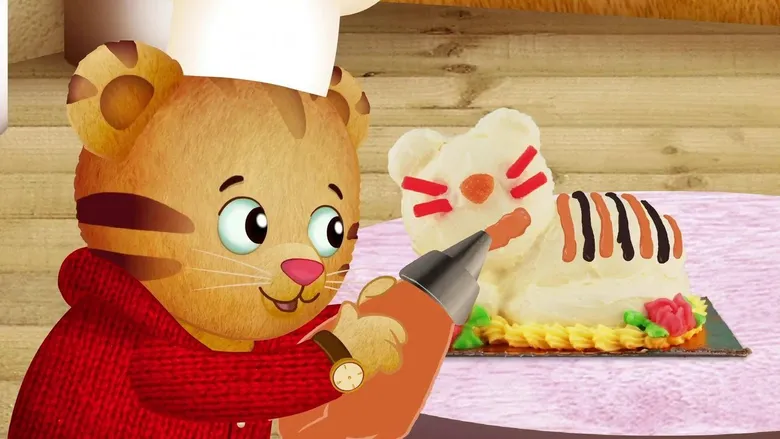
Daniel Tiger and his friends Prince Wednesday and Miss Elaina meet at the castle, ride the trolley to the clock factory park, and start a picnic with Daniel's dad nearby. After an alphabet snack game, a make-believe ant picnic, and a ball game that ends with the ball getting squashed, a sudden rain forces them inside the clock factory. They notice clocks shaped like a castle and a tiger and decide to hold their picnic indoors. The episode closes with the friends thanking the viewer and a song about turning disappointment into something good.