









This program is stimulating. It actively demands attention and can feel intense. For the recommended age, this may be on the more intense side.
The pacing is fast. Images follow each other quickly, leaving little time to pause and take in what is happening.
The sound is intense and continuously present.
The visuals are well-balanced, with a clear overall view.
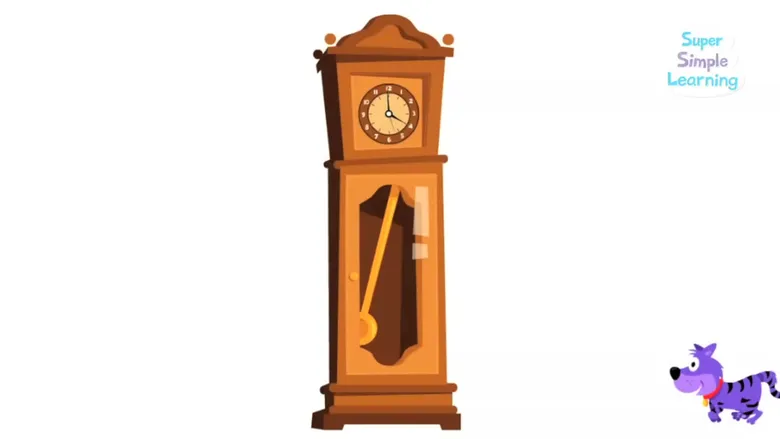
The video follows one simple thread from beginning to end: an animal goes up the clock, the clock strikes a number, the animal goes down. There is only ever one thing to follow at once, and each verse adds just a little that is new, a fresh animal and the next number, which is easy for a toddler to hold onto. The order is predictable and counts up from one to five before the surprise elephant, so a child always has a sense of what comes next. The one soft spot is that the link between an animal climbing and the clock striking is more of a rhyme pattern than a real cause and effect, so the underlying logic stays loose.
The emotional tone stays gentle and warm, carried by a soft singing voice and friendly, calm-faced animals. There is only one small bump, the surprise arrival of the elephant, where the narrator sings 'An elephant?!' and 'Oh no!', and even that plays as a light joke rather than something frightening. Right after, the familiar 'Hickory dickory dock' line and the quiet ending bring things back to calm. Nothing here is mean-spirited or mocking, so a young child is kept in a safe, predictable emotional space.
This pillar scores low because the video does not show any thinking, trying, or problem-solving. The animals simply appear and climb the clock; nothing is worked out, no goal is chased, and no choices are made. Because it is a song built on repetition, there is no moment where a character meets a difficulty and steps through how to handle it. For a child who could learn from seeing independent problem-solving modelled, there is essentially nothing to draw on here.
The language fits a two-year-old well: short, clear lines like 'The mouse went up the clock' and 'The clock struck one' use concrete, familiar words and a simple rhythm that is easy to follow and to join in with. Words are used correctly and consistently, each animal is clearly named, and counting runs from one to five. The main limitation is that a fair share of the words are rhythmic refrains, 'Hickory dickory dock' and 'tick tock', which sound pleasant and mark the beat but carry little meaning on their own. Even so, the meaningful lines do real descriptive work and suit the age.
This pillar is held down because the action lives almost entirely in make-believe: real animals like a mouse, a cat and an elephant climbing a tall grandfather clock is not something a child sees or does in daily life. There are no everyday tasks shown with clear steps to copy, and there are no family or friendship situations that mirror real relationships. What does carry over is the learning woven in, naming common animals and counting from one to five, which a parent can easily practise off-screen. Those pieces give it some real-world value, but the fantastical setup and the absence of recognisable social or practical situations keep it modest.
More information
This score shows how inclusively the series portrays diverse people, families and cultures. Scale: Limited → Varied → Rich → Inclusive.
This is a sung nursery rhyme built around a single grandfather clock, with a series of animals taking turns climbing up and back down. There are no human characters at any point, so the video offers no picture of people, families, cultures or everyday life to draw on. The cast does vary in animal terms (a mouse, a snake, a squirrel, a cat, a monkey and an elephant), and each one is treated in exactly the same way, with no animal cast as smarter, sillier or more important than the others. Because people are absent and the content is abstract, there is little for representation to build on, though nothing here pushes a narrow or stereotyped view either.
This score shows whether the series stays close to everyday reality or leans into fantasy. Scale: Fantasy → Mixed reality → Realistic.
This nursery rhyme song keeps almost everything recognizable: a tall grandfather clock and a parade of real animals, a mouse, a snake, a squirrel, a cat, a monkey, and finally an elephant. The one imaginative leap is the idea of animals climbing the clock as it strikes each hour, and that idea stays simple and consistent the whole way through. There is no villain and no good-versus-evil story; the single surprise is the elephant who is too big for the clock, played for gentle comedy. For a 2-year-old this light mix of the familiar and the playful is a comfortable match.
This score shows how enjoyable the series is for parents watching along. Scale: Tedious → Tolerable → Pleasant → Enjoyable.
This is a calm, well-produced nursery rhyme that plays mostly for the child in the room and offers an adult little to hold onto. The song repeats one refrain while a series of animals climbs the clock, so the plot stays thin apart from the closing surprise when an elephant is too big and the pattern breaks. The gentle voice, soft palette, and clean clock animation make it easy to have on in the background. For a co-viewing parent the appeal is comfort and polish rather than story or humor.
This is a sung version of the nursery rhyme 'Hickory Dickory Dock' from Super Simple Songs. In each verse a different animal, first a mouse, then a snake, squirrel, cat, and monkey, climbs a tall grandfather clock, the clock strikes the next number from one to five, and the animal climbs back down, with 'tick tock' refrains in between. The final verse brings a surprise when a large elephant arrives at the clock and the narrator sings 'Oh no!'. The video ends with a closing card showing the Super Simple Songs website and an animal-songs collection.