




























This program is well-balanced. It remains mostly easy to follow and process. It is a good fit for the recommended age.
The pacing is calm. A child has time to watch and understand what is happening.
The sound is soft and supportive.
The visuals are calm and well-organized.
The whole episode follows a single clear question: what does Blue want with her snack. Events unfold in an orderly chain, first clue, second clue, third clue, then the thinking chair, so a child always knows where they are in the story. New information arrives slowly and one piece at a time, which keeps it easy to hold onto. The reasoning links together plainly, with each clue (a cup, a straw, a cow) building toward the milk answer.
The tone stays warm and even from start to finish, with Josh offering steady encouragement like 'You're doing great' and 'I'm so proud.' The few small bumps, a spilled grocery bag or Blue saying 'no' to snack time, are resolved right away and never build into real distress. Characters treat each other with respect and behave predictably, and the affectionate 'Silly Josh' aside reads as friendly rather than mocking. Emotions shift softly, so a young child is never caught off guard by a sudden change in mood.
Problem-solving is the heart of the episode: Josh names the puzzle, gathers three clues, draws each one, and reasons his way to the answer in the thinking chair. He models thinking out loud and openly asks for help when he is unsure, calling his cousins Steve and Joe, which shows a child that not knowing is fine. The cause-and-effect reasoning is clear and satisfying, working from cow, to the sound a cow makes, to the milk we drink. The main goal is set off by Blue rather than by Josh himself, which slightly tempers his own initiative, but the steps he takes to solve it are his own.
Language is simple, concrete, and closely matched to a young child, built around short clear sentences and plenty of friendly repetition. Words are used correctly and consistently, and Josh speaks clearly enough that a child can follow every step. The call-and-response style leans on single words like 'Clue!' and 'Notebook!', which is fitting at this age even though it means not every line is a full sentence. Most of the talk carries real information or instruction, with repetition that reinforces meaning rather than filling space.
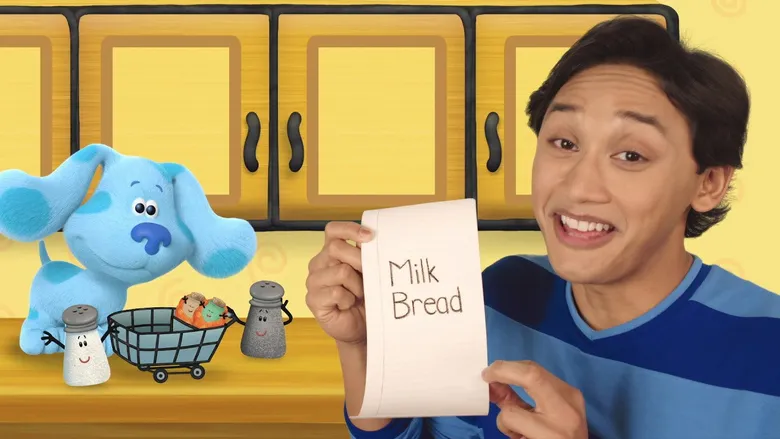
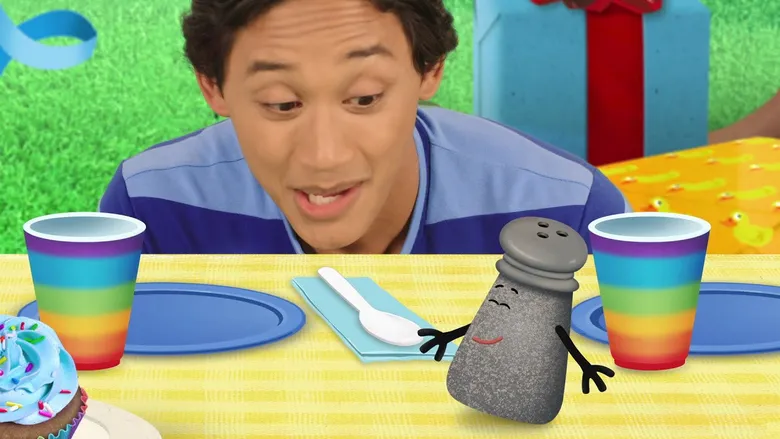
Some of what a child sees connects straight to daily life: pouring milk into a cup, cleaning up a spill, drawing, and sharing a snack at the table. The reasoning skills and the social moments, helping a friend and asking family for help, are recognisable and useful. The clear limitation is how much of the episode leans on fantasy that cannot carry over offline: a talking puppy, chatty salt and pepper shakers, and Josh 'skadooing' into an animated farm where chicks and cows talk. For a three-year-old this mix is enjoyable, but the directly transferable, real-world share of the episode is only part of the whole.
More information
This score shows how inclusively the series portrays diverse people, families and cultures. Scale: Limited → Varied → Rich → Inclusive.
The heart of this episode is Josh, a Filipino-American host who guides the story from start to finish, which places a person of color at the center rather than the margins. Around him the human variety is thinner: his cousins Steve and Joe appear briefly through video calls, and a short welcome message shows children of different ethnic backgrounds, but most of the runtime rests on one person. Roles are handled evenly, with Josh cast as the newcomer who needs help and the child at home positioned as the capable helper, while Mr. Salt and Mrs. Pepper share kitchen tasks as an equal pair. The one visible pattern is that the host chair has been passed among men only, from Steve to Joe to Josh.
This score shows whether the series stays close to everyday reality or leans into fantasy. Scale: Fantasy → Mixed reality → Realistic.
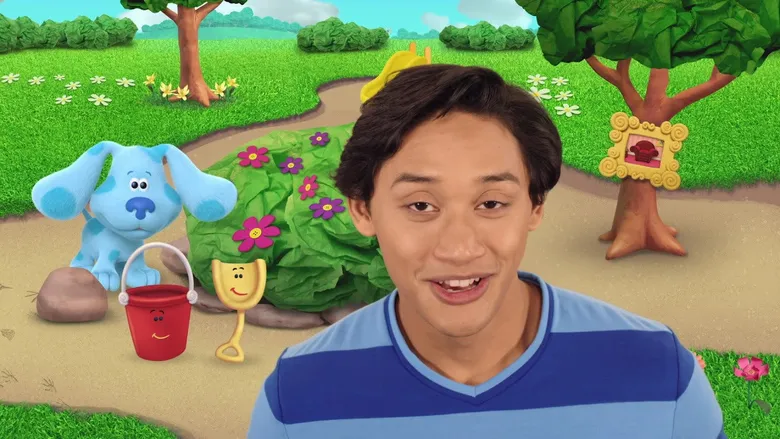
Josh, a real person, hosts from a bright animated house where he solves a small everyday puzzle: figuring out what Blue wants with her snack, which turns out to be milk in a cup with a straw. The situation is drawn from real life, but the world around it is playful and imagined, with a talking mailbox, chatty salt and pepper shakers, an animated puppy who answers in barks, and a magical jump into a picture of a farm. There is no villain anywhere; the gentle mystery comes from the situation, not from any character working against Josh. The fantasy stays consistent to its own familiar rules, and the calm, repetitive, question-and-answer style fits young preschoolers well.
This score shows how enjoyable the series is for parents watching along. Scale: Tedious → Tolerable → Pleasant → Enjoyable.
This premiere rewards the grown-up in the room more than most in this genre, largely because Josh's two predecessors, Steve and Joe, appear by video call to hand off the role, a moment aimed squarely at parents who watched the original. The mystery itself is thin, a three-clue guessing game about what Blue wants with her snack, but the framing of Josh learning the ropes gives it a light through-line. It is easy on adult ears and eyes: warm voices, calm pacing, and a bright, clean look with only gentle song repetition. Craft is a real strength, blending a live-action host with polished animation and a tidy sound mix.
Josh, the new host of the Blue's Clues game, arrives home and tries to work out what his puppy Blue wants with her snack. With help from the viewer and a video call to his cousins Steve and Joe, he finds three paw-print clues, a cup, a straw and a cow, drawing each in his notebook and visiting an animated farm along the way. Sitting in his thinking chair, he reasons that cows make milk, so Blue wants milk poured in a cup to drink with a straw. The episode ends with a snack party and a closing song.