

Slowscreen SlowScreen
Toggle sidebar

Just launched: free lifetime premium for the first 1,000 members to activate their account.

Start free

I Love To Conduct

Sufficient

Recommended age Unlock

Co-watching from age 2

Stimulating

Exact score locked

Watch on Disney+
Save
I Love To Conduct

Share

Pass this find on to another parent

Link preview

Little Einsteins: I Love To Conduct | Sufficient, co-watching from age 2

Little Einsteins: I Love To Conduct | Sufficient, co-watching from age 2 - Slowscreen

Sufficient · Co-watching from age 2. Leo, Annie, Quincy and June set out in their rocket after a bald eagle carries off Leo's beloved conducting baton. Their ch...

slowscreen.com

https://slowscreen.com/en/series/little-einsteins/s1/e2-i-love-to-conduct

https://slowscreen.com/en/series/little-einsteins/s1/e2-i-love-to-conduct

Slowscreen

Little Einsteins: I Love To Conduct | Sufficient, co-watching from age 2 - Slowscreen

Sufficient · Co-watching from age 2. Leo, Annie, Quincy and June set out in their rocket after a bald eagle carries off Leo's beloved conducting baton. Their ch...

Little Einsteins: I Love To Conduct | Sufficient, co-watching from age 2

slowscreen.com

Little Einsteins: I Love To Conduct | Sufficient, co-watching from age 2 - Slowscreen

Sufficient · Co-watching from age 2. Leo, Annie, Quincy and June set out in their rocket after a bald eagle carries off Leo's beloved conducting baton. Their ch...

Little Einsteins: I Love To Conduct | Sufficient, co-watching from age 2
slowscreen.com

Little Einsteins: I Love To Conduct | Sufficient, co-watching from age 2 - Slowscreen

slowscreen.com · Posted by you

Little Einsteins: I Love To Conduct | Sufficient, co-watching from age 2 - Slowscreen

0 Share
Little Einsteins: I Love To Conduct | Sufficient, co-watching from age 2
To
Subject Little Einsteins: I Love To Conduct | Sufficient, co-watching from age 2

Sufficient · Co-watching from age 2. Leo, Annie, Quincy and June set out in their rocket after a bald eagle carries off Leo's beloved conducting baton. Their ch...

https://slowscreen.com/en/series/little-einsteins/s1/e2-i-love-to-conduct

Share on WhatsApp Share on X Share on Facebook Share on Telegram Share on Reddit Share on Email

See the exact scores

The review is yours to read. Create a free account to reveal the exact SlowScreen score and every pillar score.

Create free account
The image and sound rarely settle for long. Cuts arrive quickly, music runs almost the whole way through, and the characters are in near-constant motion as they chase the eagle across mountains, forests and open water. There are a few calmer nature shots, like the slow sunrise and the wildlife waking, but they are brief islands in a busy stream. The episode also leans hard on direct participation, repeatedly telling the child to 'pat, pat, pat', clap the beat and shout 'blast off', which keeps the pressure on the viewer rather than giving real breathing space.
One clear goal runs from start to finish: a bald eagle takes Leo's baton and the team sets out to get it back. Events build in a logical order, with a recognizable beginning, a journey with obstacles, and a resolution when Leo climbs to the nest and reclaims it. Actions lead to sensible results the child can follow, such as singing louder so the animals notice, or the wolf passing the message on to the whales. A lot of new information is packed in, from crescendo and diminuendo to bald eagles, volcanoes and lava, which asks a fair bit of a young viewer even though it stays followable.
The tone between the four friends is warm and supportive throughout. They cheer each other on ('Way to go, Leo', 'You can do it'), take turns using their own talents, and treat one another with respect and consistency. There is a stretch of tension around the rumbling volcano, with worried faces and 'It's going to blow', but it is followed by a clear recovery when Quincy's soft flute playing quiets it and the group escapes safely. A few switches between excitement and worry come on quickly, which is the main thing keeping this from feeling fully settled.
The children drive the action themselves and each takes initiative with a skill they love, whether conducting, singing, playing the flute or dancing across the whales. When they get stuck they name the problem and propose a plan, such as Quincy deciding to play softer and softer to calm the volcano. Solutions usually show a few visible steps and clear cause and effect, though some are solved quickly once the idea appears. Leo's final climb to the nest, where he sizes up the reach, runs and grabs the baton, is the clearest example of working something out.
The language is clear and mostly matched to young listeners, with short explanations that unpack new words in context, like 'crescendo' meaning the music gets louder and 'lava' being hot melted rock. Characters speak in complete, understandable sentences and use words consistently, which helps the meaning land. Alongside the informative lines there is a steady stream of expressive filler, from repeated 'la la la' singing to 'yay' and 'woo-hoo', which dilutes how much of the talk actually carries content. Overall the words are purposeful more often than not.
There is real-world material woven in: music concepts, a famous painting, bald eagles building nests, Mount St. Helens as a volcano, redwoods and orca whales. Some of what is shown can carry over to a child's own life, such as clapping a beat, singing, or waving a baton to conduct. At the same time the frame is heavily imaginative, with a talking rocket, a baton that seems to wake the sun and children leaping across whales, so the practical takeaway is mixed. The friendship and teamwork dynamics are recognizable and grounded, which adds everyday value.

More information

This score shows how inclusively the series portrays diverse people, families and cultures. Scale: Limited → Varied → Rich → Inclusive.
The four children at the center are a natural mix of backgrounds. Leo and his younger sister Annie are white, June has East Asian features, and Quincy is Black, and they move through the story as a close, equal team. Each child leads one part of the adventure using a talent, so initiative and problem-solving are shared rather than handed to one type of character every time. The main limits are that everyone is roughly the same age, no adults or other family forms appear, and the range of bodies and life stages stays narrow.
This score shows whether the series stays close to everyday reality or leans into fantasy. Scale: Fantasy → Mixed reality → Realistic.
The world blends the recognizable with the imagined. Real places like Mount St. Helens and California's redwood forest, real animals like bald eagles and orca whales, and real classical music sit alongside a talking rocket ship, singing to wake the sun, and dancing across the backs of whales. There is no villain: the whole adventure begins when a bald eagle mistakes Leo's baton for a nest stick, and even she is treated kindly at the end. The fantasy follows its own steady logic and lands comfortably for children in this age range.
This score shows how enjoyable the series is for parents watching along. Scale: Tedious → Tolerable → Pleasant → Enjoyable.
This one gives a watching adult more to hold onto than most in its age bracket. The soundtrack is built on real classical music (Grieg's Peer Gynt), the episode pauses to show a genuine fine-art painting, and the story is a proper chase across recognizable landscapes rather than a looped activity. The trade-off is the constant call-and-response: the repeated 'pat, pat, pat' chants, stretches of 'la, la, la' and the drilled music words ask for your patience. Craft is strong, so it plays as a pleasant background more often than a grating one.

Themes

Attention hooks

The characters repeatedly direct the viewer to pat, clap and shout along, such as 'Put your hands on your lap and pat with us'.

Danger

A rumbling volcano nearly erupts on the team with worried cries of 'It's going to blow!' before it is calmed.

Loud sounds

The crescendo of the erupting volcano is described as 'so loud' with a matching audio swell.

Leo, Annie, Quincy and June set out in their rocket after a bald eagle carries off Leo's beloved conducting baton. Their chase takes them across a volcano, a redwood forest and open ocean, where each child uses a favorite talent to get past obstacles and ask animals for help. Along the way the episode teaches music terms, art and geography, set to Grieg's 'Morning Mood'. Leo finally climbs to the eagle's nest, reclaims his baton and the team celebrates with a Curtain Call.

Season 1

5 episodes

Little Einsteins
S01 E01

Little Einsteins

Ring Around the Planet

Stimulating
recommended age Unlock co-watching from 2

June spots a ring fall from Saturn through her telescope, and she and her friends Leo, Quincy and Annie set out in their rocket to return it home. Along the way they push meteors away by drumming, get freed from a space jam by friendly aliens called meeps, and use singing to grow and shrink the ring. The team reaches Saturn and helps the ring settle into place around the planet. The episode closes with a curtain call that names the artist Gustav Klimt and Dvorak's Symphony No. 9.

Little Einsteins
S01 E02

Little Einsteins

I Love To Conduct

Stimulating
recommended age Unlock co-watching from 2
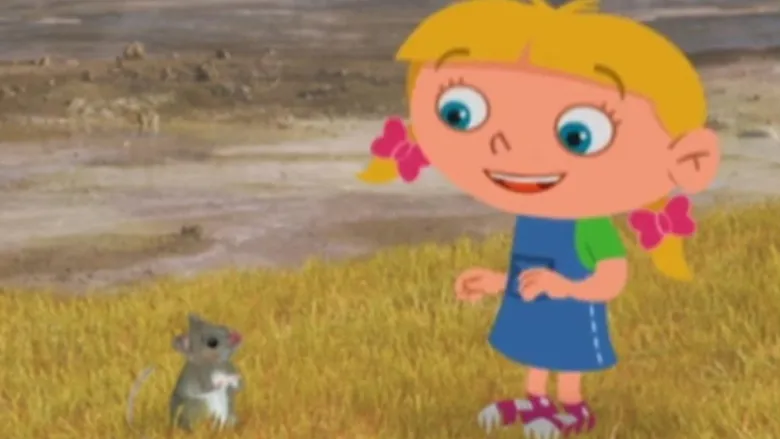
Leo, Annie, Quincy and June set out in their rocket after a bald eagle carries off Leo's beloved conducting baton. Their chase takes them across a volcano, a redwood forest and open ocean, where each child uses a favorite talent to get past obstacles and ask animals for help. Along the way the episode teaches music terms, art and geography, set to Grieg's 'Morning Mood'. Leo finally climbs to the eagle's nest, reclaims his baton and the team celebrates with a Curtain Call.

Little Einsteins
S01 E03

Little Einsteins

Hungarian Hiccups

Balanced
recommended age Unlock co-watching from 2
Leo, Annie, Quincy and June discover that their rocket ship friend has the hiccups just before the Great Sky Race. They fly to Orchestra Ocean for cymbals, into a jungle for a tiger's roar and to a geyser, trying ever bigger surprises to cure him. Nothing works until a tiny mouse startles the hiccups away, and Rocket goes on to win the race. The episode ends with a curtain call naming the featured Rousseau painting and Brahms music.

Little Einsteins
S01 E04

Little Einsteins

Whale Tale

Balanced
recommended age Unlock co-watching from 2
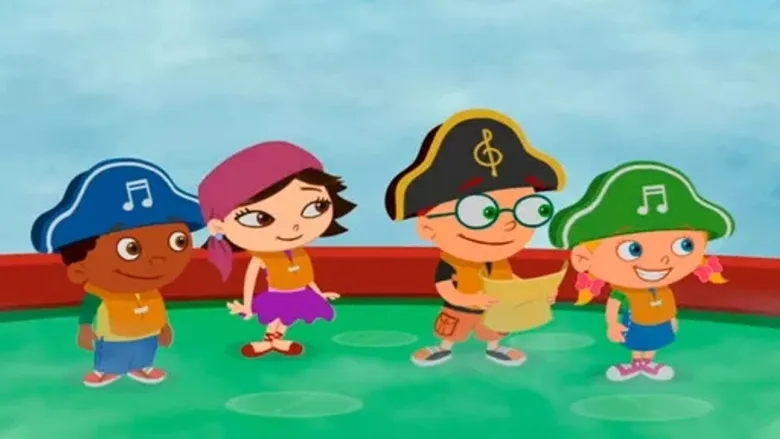
Leo, Annie, Quincy and June set out in their rocket ship after their friend Rocket becomes sad about leaving Little Whale at the seashore. The rocket transforms into a submarine and the team searches the ocean, passing coral reefs, a sea turtle, a giant squid and a shark while comparing whale songs and instrument sounds to find the way. Using horns and then conch shells, they call loudly enough for Little Whale and his family to hear. The two friends reunite, and the episode ends with a 'Curtain Call' honoring Mozart's music.

Little Einsteins
S01 E05

Little Einsteins

Pirate's Treasure

Balanced
recommended age Unlock co-watching from 2
Leo, June, Annie and Quincy dress up as pirates in their Rocket Room and discover a musical map that leads to buried treasure. Guided by the map's crescendos, beats and buoys, they travel across the Pacific Ocean and underwater in Rocket, racing the rival Big Jet who wants the treasure first. The children invite the viewer to pat, count and whistle along at each step. They reach the X, dig up a nautical whistle, drive Big Jet away, and close with a Curtain Call reviewing the art and music.

Just launched: free lifetime premium for the first 1,000 members to activate their account.

Create your account

Search by title, show, tag, or topic

We use functional cookies and Google Analytics to improve our site. Learn more