


















This program is well-balanced. It remains mostly easy to follow and process. It is a good fit for the recommended age.
The pacing is fast. Images follow each other quickly, leaving little time to pause and take in what is happening.
The sound is soft and supportive.
The visuals are busy, with a lot of movement and frequent changes.
This episode is easy to follow, with one clear goal driving everything, getting one hundred escaped chickens back into the coop before the farmer notices, and a beginning, middle and end you can track. Cause and effect is plain, leaving the coop door open lets the chickens out, and sorting them by size lets them be moved. The one caveat is that the counting and number talk can pile up, asking a young child to hold several ideas at once. A callback to the earlier pie problem neatly ties the ending back to the start.
The tone is mostly warm, and the episode models a genuinely useful calming tool when Peg counts backwards from five to settle herself after a wave of panic. The limitation is the panic itself, which returns more than once with Peg announcing she is 'totally freaking out', and the way Pig is treated, with Peg telling him he is no good at solving problems 'cuz you're a pig'. Those jabs land in a cheerful voice but still poke fun at a friend. Tension does resolve close to where it appears, so worry does not linger for the child.
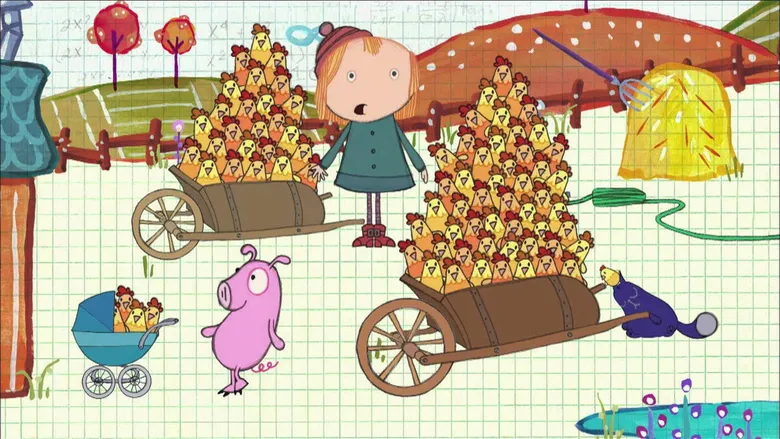
This episode stands out for showing real problem-solving. Peg and Cat own the problem from the start and work through it by trying things out, carrying chickens by hand, attempting a chicken race, then borrowing wheelbarrows, learning from each attempt that does not work. The reasoning is spoken aloud and holds together, with Peg explaining that putting 'big with big and small with small' is what finally lets them move all one hundred chickens. Children see persistence, a plan that adjusts after a failed try, and a clear link between thinking and result.
Most of the language is concrete and useful, built around words a young child knows like chickens, pie, big and small, and the counting reinforces meaning rather than filling space. The drawback is clarity, with some lines running together or trailing off so parts are harder to follow. A few asides also sail over a preschooler's head, like Cat belonging at a university 'talking about algebra and the president and the stock market'. The core math vocabulary, though, stays clear and purposeful.
There is genuine real-world value here, with counting, comparing big and small, and sorting by size being skills a child can carry straight into daily life, and the farm, picnic and chickens are recognisable. What holds it back is the layer of fantasy around those skills, a talking cat, a singing pig and a world drawn over floating numbers, which sits between the lesson and everyday life. The social setup is familiar though, with friends pitching in and one character lending a hand when asked. For a three-year-old the practical core is usable, wrapped in playful invention.
More information
This score shows how inclusively the series portrays diverse people, families and cultures. Scale: Limited → Varied → Rich → Inclusive.
This farm adventure centers on Peg, a young girl who takes charge of every problem, helped by her cat and by Ramone, a brown-skinned boy shown as a skilled inventor whose work everyone relies on. The human cast is small and the action stays in one barnyard world, so the overall picture of how people live is fairly narrow. Within that frame, roles are shared fairly: the characters cooperate as equals and initiative is not tied to one group. There is some ethnic variety and a girl at the heart of the story, but little in the way of different families, ages or everyday settings.
This score shows whether the series stays close to everyday reality or leans into fantasy. Scale: Fantasy → Mixed reality → Realistic.
This farm story stays close to a child's real world, with chickens, a pig, a cow, corn, and a picnic of pie cut into different sizes, and only light touches of make-believe such as a talking cat and a closing song of singing numbers. There is no villain anywhere; the trouble comes from a practical situation, getting 100 escaped chickens back into the coop before the farmer returns, which Peg, Cat, and the pig solve together. The gentle fantasy stays consistent from start to finish, and the blend of recognizable farm life with simple counting fits this age comfortably.
This score shows how enjoyable the series is for parents watching along. Scale: Tedious → Tolerable → Pleasant → Enjoyable.
Peg + Cat is comfortable company for a parent watching along. Cat's deadpan humor and the steady wordplay give adults something to catch, while a real chase plot, getting a hundred runaway chickens back before the farmer notices, holds interest on its own. The jazzy music and calm voices keep it easy on the ears, with only mild refrains and the odd panic to wear on you. The hand-drawn, graph-paper look is a deliberate craft choice that lifts the whole thing.
Themes
Numbers
Central
Chickens are counted aloud from one to ten and the number one hundred is repeated as 'way more than ten'.
Peg and her cat are spending a sunny day on a farm when Cat accidentally leaves the chicken coop open and all one hundred chickens escape. With help from a pig and their friend Ramone, they try several ways to round the chickens up before the farmer notices, from carrying them by hand to holding a chicken race. They finally succeed by sorting the chickens and wheelbarrows by size, matching big with big and small with small. The chickens end up safe back in the coop and everyone joins the picnic, singing about numbers and sizes.