

















This program is well-balanced. It remains mostly easy to follow and process. It is a good fit for the recommended age.
The pacing is fast. Images follow each other quickly, leaving little time to pause and take in what is happening.
The sound is clearly present and regularly draws attention.
The visuals are well-balanced, with a clear overall view.
The story follows one thread from start to finish: find seeds, plant them, wait, discover what they are. Events arrive one at a time with breathing room between them, and the narrator marks each step ('why not plant them and see what grows', 'they must be onions though they don't look quite big enough'). New information appears in small doses, like one new vegetable name or one new action per scene, which fits a young preschooler comfortably. Cause and effect is visible throughout: seeds in soil plus time plus light leads to little shallots poking up.
The emotional register stays warm and steady from the first frame to the last. Voices stay quiet and friendly, Sarah is patient with muddy Duck and gentle with the tiny shallots, and the narrator offers supportive comments rather than instructions ('quite right, carry on'). Small moments of mild frustration, like nothing growing yet, are resolved within the same scene by switching to dinner or bedtime. There are no scary sounds, no villains, and no abrupt mood swings.
Sarah drives the action herself: she decides to plant the seeds indoors, fetches the vegetable book when she does not recognise the sprouts, and helps Duck warm up the shallots in the sun. The episode shows multiple visible steps of figuring something out, including naming the problem ('what are they?'), making a guess ('they must be onions'), checking the book, and arriving at a more accurate answer ('they're shallots, baby onions'). The chain from observation to book to conclusion is clear enough for a three-year-old to follow with an adult.
Speech is clear, calmly paced and grounded in what is on screen, with consistent word use for 'seeds', 'shallots', 'root vegetables' and 'grow'. The pillar score is held back by language that drifts above the 2 to 4 year band: figurative lines like 'easy mistake to make' and 'your shallots may have learned a thing or two', and some longer narrator sentences that a three-year-old will likely not fully parse. Vocabulary is mostly concrete but introduces specialised garden terms ('shallots', 'root vegetables', 'turnip') without strong picture-by-picture reinforcement.
The core activity, planting seeds in soil and waiting for them to grow, is directly transferable to a child's own garden, balcony pot or windowsill, and the vegetable book scene mirrors how children actually learn the names of foods. The pillar score is held back by the show's fantasy layer: the shallots become small characters who need warming up and 'lessons' from Duck, and the Plate Girl appears to thank Sarah. For a three-year-old this sits at the edge of light imagination versus full fantasy, which limits the realistic anchoring of the lesson even though the gardening thread itself is recognisable.
More information
This score shows how inclusively the series portrays diverse people, families and cultures. Scale: Limited → Varied → Rich → Inclusive.
This episode focuses almost entirely on Sarah, a pale-skinned young girl, and her companion Duck, with a male narrator's voice and a small group of talking shallots appearing later. No other human characters, family members, caregivers, or cultural backgrounds are visible, so the world the child sees is very narrow. Within that small cast, Sarah leads the activity, makes decisions, and cares for Duck, which counters passive-girl clichés. Overall, the episode is limited in who appears on screen but balanced in how its one main character behaves.
This score shows whether the series stays close to everyday reality or leans into fantasy. Scale: Fantasy → Mixed reality → Realistic.
Sarah and Duck blends an everyday domestic setting (a living room, simple garden patches, a vegetable book) with consistent gentle fantasy: Duck understands speech and quacks back meaningfully, an unseen narrator chats directly with Sarah, and the planted shallots sprout little faces and personalities overnight. There is no villain anywhere in the episode; conflict comes only from impatience and a small misunderstanding about how big shallots grow. The fantasy elements follow steady internal rules and never tip into chaos. For a 3-year-old in the 'mostly realistic, light imagination' band, the imaginative layer sits a touch above ideal but stays warm, slow and easy to follow.
This score shows how enjoyable the series is for parents watching along. Scale: Tedious → Tolerable → Pleasant → Enjoyable.
Sarah and Duck stands out as one of the most adult-friendly preschool shows around. The dry, understated narrator carries a layer of British humor that works for a co-viewing parent, the story has a real arc with a small twist at the end, and the watercolor visuals and quiet sound design are easy on adult senses. There is very little that would grate, and the craft is consistently high.
Themes
Gardening
Central
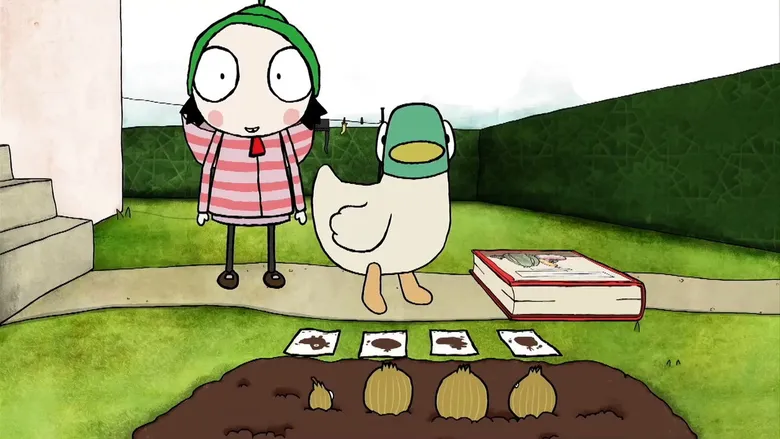
Sarah and Duck plant seeds in planters in the living room and tend them until they sprout into shallots.
Sarah and Duck find tiny seeds tucked inside their newspaper and decide to plant them in pots in the living room. They water the soil, get muddy, clean up and then wait through dinner and bedtime for something to happen. The next morning small sprouts appear, and Sarah looks them up in her vegetable book before a character called the Plate Girl arrives to confirm they are shallots, the baby onions that stay small. The episode ends with Duck giving the little shallots gentle 'lessons' in the garden.