













This program is stimulating. It actively demands attention and can feel intense. For the recommended age, this may be on the more intense side.
The pacing is fast. Images follow each other quickly, leaving little time to pause and take in what is happening.
The sound is clearly present and regularly draws attention.
The visuals are busy, with a lot of movement and frequent changes.
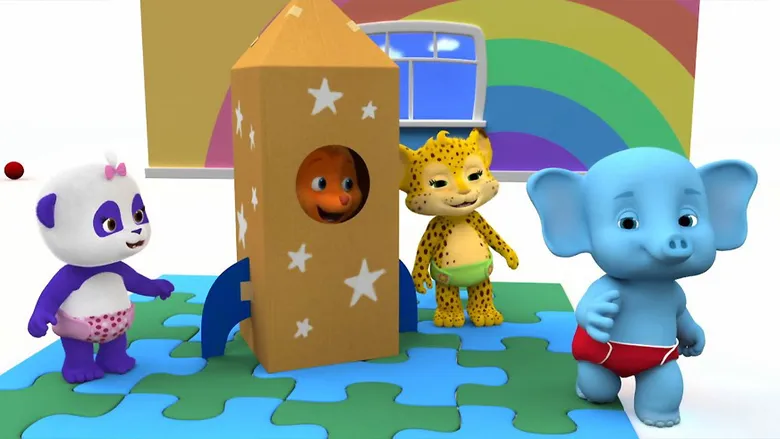
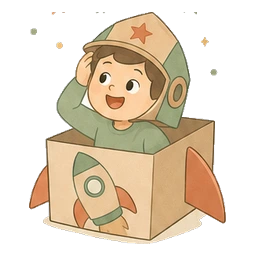
One clear thread runs the whole way through: a single cardboard box becomes a fire truck, a sailboat, an airplane and finally a rocket to the moon. Events follow in order with a recognisable beginning, middle and end, and new ideas arrive one at a time so a young child can follow along. When the babies build something, the result follows logically from what they decided to do. The only slight wobble is a couple of song interludes that briefly pause the story.
The tone stays warm and supportive: the babies cheer each other on and comfort Kip with 'that's okay, something will pop into your head' when he cannot think of a word. Feelings stay gentle, and the small dip when Kip says 'I never get to choose' is resolved when he is given the next turn to pick. Mood shifts are smooth rather than sudden. One brief moment where the others say 'no, we like this game' is corrected soon after.
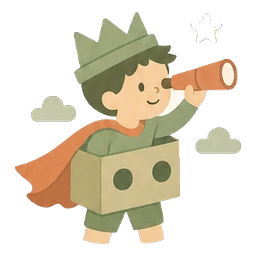
The babies come up with their own pretend ideas and think out loud about which vehicle to choose, which gives some sense of working a problem through. Still, most builds are described and then shown already finished, so the steps of trying, checking and adjusting are rarely seen. Kip's struggle to name a vehicle is the clearest thinking moment, helped along by the telescope and the others' encouragement. Solutions tend to land in one jump rather than through visible effort.
Language fits a young preschooler well, with short clear sentences and concrete words, and vehicles are explained in plain terms: a fire truck 'helps put out fire', a sailboat 'sails on the water', an airplane 'flies through the air'. New words like 'telescope', 'planets' and 'rocket' are introduced with a quick explanation. The drawback is the steady stream of 'um' and 'uh' filler and some mumbled baby talk that muddies a few lines. Repetition of the vehicle words reinforces their meaning rather than padding.
Playing with a real cardboard box is something a child can copy straight away, and the turn-taking and cheering reflect everyday play with friends. Learning the vehicle words also carries over to daily life. What limits the real-world link is the fantasy frame: talking animal babies and an actual trip to the moon sit alongside the grounded box play. The builds are also shown finished rather than made step by step, so there is less to follow and imitate.
More information
This score shows how inclusively the series portrays diverse people, families and cultures. Scale: Limited → Varied → Rich → Inclusive.
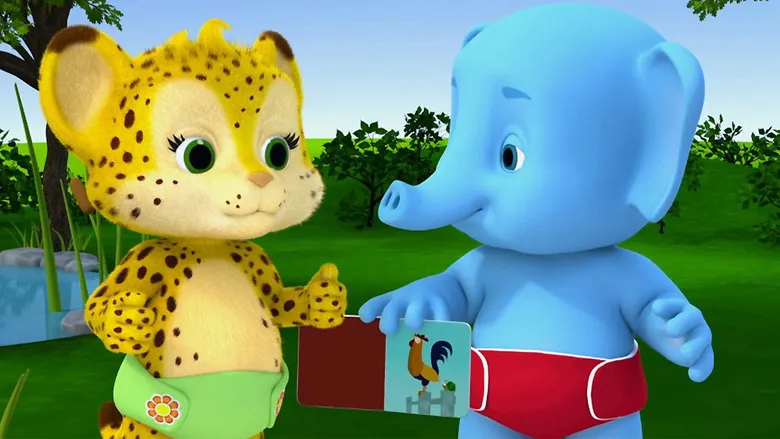
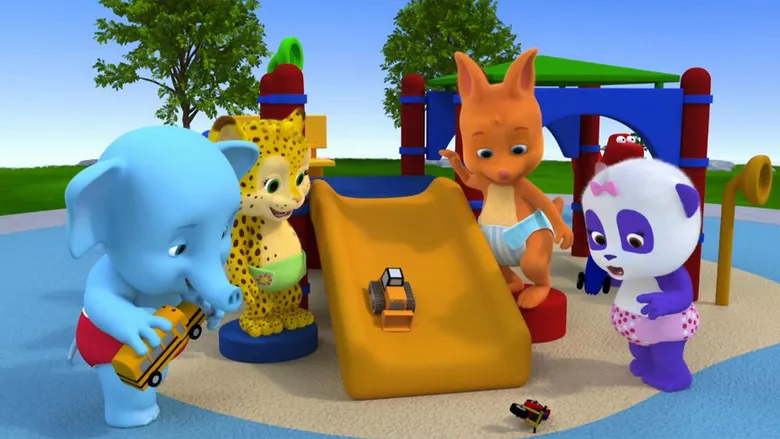
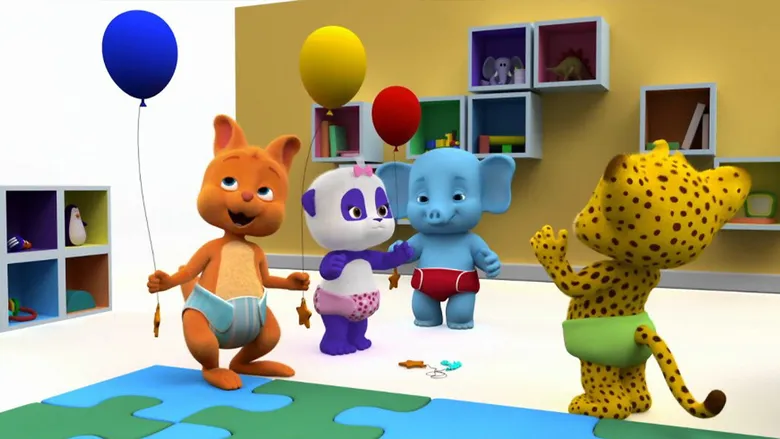
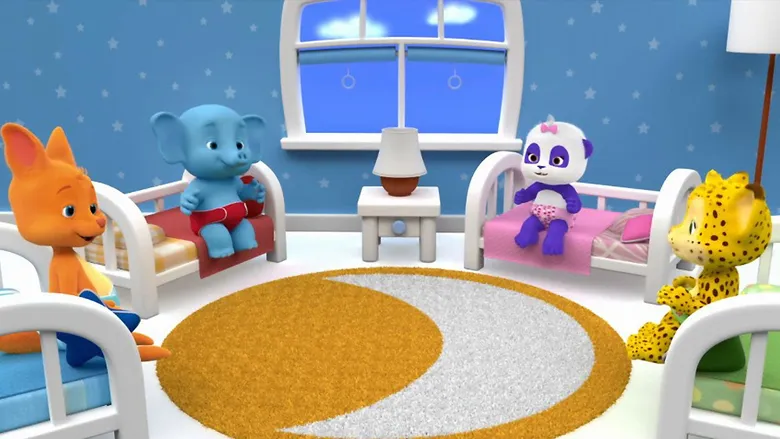
Word Party brings together a small group of baby animals, a lion, an elephant, a panda and a wallaby, who play and learn new words in a single playroom alongside a few friendly helper characters like a talking clock and a toy. Because the whole cast is animals, the everyday markers of human diversity, different cultural backgrounds, family forms or living situations, are not part of the picture, and the world stays in one room throughout. Within that narrow setting the characters share the spotlight evenly, take turns leading the game and help one another rebuild a box into a sailboat, an airplane and a rocket. The feel is cooperative and even-handed in behaviour, even though the visible breadth of who is represented is limited.
This score shows whether the series stays close to everyday reality or leans into fantasy. Scale: Fantasy → Mixed reality → Realistic.
The babies turn an ordinary cardboard box into a fire truck, a sailboat, an airplane and finally a rocket, all through pretend play they narrate out loud. The world is a familiar playroom and the make-believe stays clearly framed as imagination, so children can map it straight onto their own games. There is no villain anywhere; the only friction comes from sharing turns and picking the next game, and it is always sorted out kindly. The gentle blend of real-life play and light imagination is a comfortable fit for a three-year-old.
This score shows how enjoyable the series is for parents watching along. Scale: Tedious → Tolerable → Pleasant → Enjoyable.
The production itself is polished, with clean animation, a consistent bright look and a clear mix where speech stays front and center. For the adult in the room there is little to hold onto: the humor and references stay firmly at toddler level, and the story is a thin pretend-play game stretched with repeated chants and naming songs. A small thread about Kip struggling to think of a vehicle gives the episode some shape. The chanted 'we can do it, yes we can' and the squeaky baby voices are the main things that wear on a grown-up listener.
Themes
Vehicles
Central
The babies name and pretend to ride a fire truck, sailboat, airplane and rocket.
A group of baby animals play together in their playroom and turn one big cardboard box into a series of pretend vehicles. With help from the viewer they name a fire truck, a sailboat and an airplane, then learn the new word 'rocket'. Kip, who keeps struggling to think of a vehicle, finally chooses to pretend they fly to the moon. The episode ends with Kip blasting off, seeing the moon and stars, and waving goodbye.