





























This program is well-balanced. It remains mostly easy to follow and process. It is a good fit for the recommended age.
The pacing is fast. Images follow each other quickly, leaving little time to pause and take in what is happening.
The sound is soft and supportive.
The visuals are calm and well-organized.
One clear question carries the whole episode: how can Rosie send a birthday party to Abuela who lives far away in Mexico City. Events unfold in a clean order, she discovers the birthday, packs a party in a box, then learns she needs a name, an address, and postage before the mail carrier can take it. Each new idea builds on the last with cause and effect a child can follow, such as needing the address so the carrier knows where to go. New information arrives in digestible pieces rather than all at once.
The emotional world here is warm and steady. Rosie's family listens, explains patiently, and cheers her on, and the sisters and parents treat each other with respect rather than teasing. When Rosie grows impatient waiting for the mail carrier and needs to 'flop' to let her feelings out, the moment is met with a gentle breathing routine and then play, so the small wobble resolves soon after it appears. Feelings shift gradually and land safely, closing on a happy family video call with Abuela.
Rosie drives the whole problem herself, from deciding to mail a party to figuring out each missing piece along the way. She tries an idea, hits a snag ('I can't tell where this birthday fiesta is going'), and adjusts, gathering the address, then the postage, then waiting for the carrier. The steps are visible and repeated back by Rosie, so the thinking process is on display rather than solved for her. Adults guide with information, but the initiative and the plan stay hers.
Language is clear, purposeful, and pitched well for this age. New words like 'address' and 'postage' are introduced and immediately defined in plain terms, for example 'An address is the place where someone lives.' Spanish phrases and playful rhymes such as '¿Qué pasa, calabaza?' ('What's up, pumpkin?') are woven in naturally alongside English. Sentences are complete and speech is easy to follow, with most talk serving to inform or describe rather than just exclaim.
This episode connects directly to real life: mailing a package, writing a name and address, paying postage, and celebrating a family birthday from a distance are all things a child can recognize and try offline. Steps are shown concretely, from labeling the box to handing it to the carrier, so the actions transfer beyond the screen. A brief wizard daydream is clearly framed as Rosie's imagination and does not blur the real-world lesson. The family and neighborhood dynamics, including an intergenerational bond with Abuela, mirror everyday relationships.
More information
This score shows how inclusively the series portrays diverse people, families and cultures. Scale: Limited → Varied → Rich → Inclusive.
The episode centers on Rosie and her Mexican-American family in Texas, moving fluidly between Spanish and English as they plan a birthday celebration for Abuela in Mexico City. The cast reaches beyond the family to a neighborhood that includes a mail carrier who wears a hijab, a friend with glasses, and children of different skin tones at the closing video-call party. Rosie drives the story with her own questions and figuring-out, while her parents, older sister, and the mail carrier each contribute knowledge and help without taking over. Both what you see and how characters behave present a broad, matter-of-fact picture of people living and working together.
This score shows whether the series stays close to everyday reality or leans into fantasy. Scale: Fantasy → Mixed reality → Realistic.
This episode stays close to a young child's real world. Rosie wants to celebrate her grandmother's birthday, but Abuela lives far away in Mexico City, so Rosie learns how the mail works by sending a party in a box with a name, address, and postage. There is no villain and no magic driving the story; the one flight of fancy, a song about a wizard and a mouse delivering mail, is clearly Rosie's daydream and is gently corrected by the end. The realism and light imagination fit a five-year-old comfortably.
This score shows how enjoyable the series is for parents watching along. Scale: Tedious → Tolerable → Pleasant → Enjoyable.
For a watching parent this holds up better than most preschool fare. The story has a real shape, Rosie wants to throw her grandmother a party but learns she lives too far away, so she works out how to mail one, and the craft is clean and warm throughout. The playful Spanish banter and the affectionate family give you something to smile at, though the humor stays mostly pitched at the child in the room. A repeated mail song and Rosie's constant excitement can wear thin, but nothing here grates.
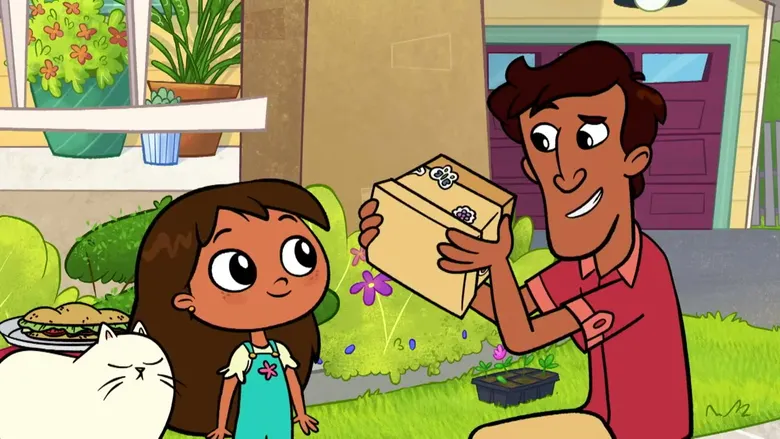
Rosie Fuentes learns it is Abuela's birthday but Abuela lives far away in Mexico City. She decides to mail a whole birthday party in a box, and with help from her family she works out that she needs a name, an address, and postage before the mail carrier can send it. She grows impatient waiting, calms herself, and finally hands the box to Miss Maya. The episode ends with the family gathering for a video call to celebrate Abuela's birthday together.